

A kitchen sink is the hardest-working object you own, hit by water, knives, hot pans, and coffee grounds dozens of times a day. So the modern picks worth your money are the ones where good looks and hard wearing arrive together, where the basin that photographs beautifully is also the one that shrugs off a decade of real cooking.
Below are the modern sink designs that earn both halves of that bargain, sorted by material, mounting, and bowl layout so you can match one to how you actually cook. I have priced the main options and flagged the catch on each, because the prettiest sink is a daily regret if it scratches, stains, or cannot fit a sheet pan.
Choosing a Modern Sink, Answered Fast
What is the most practical modern sink material? Stainless steel and composite granite. Stainless is tough and affordable; composite resists scratches and stains and comes in matte colors. Fireclay looks classic but costs and weighs more.
Undermount or drop-in? Undermount looks cleaner and wipes crumbs straight in, but it needs a solid counter like stone or quartz. Drop-in suits laminate and is the budget, renovation-free choice.
Single bowl or double? A big single bowl handles sheet pans and stockpots best and suits dishwasher households. A double bowl helps if you hand-wash and like to separate soaking from rinsing.
Durable Modern Kitchen Sinks

Before any finish, decide how much abuse your sink will take, since that points you to the right material faster than any photo can. A household that cooks nightly, scrubs cast iron, and runs the disposal hard needs a basin built for it. The modern materials that handle that punishment are stainless steel, composite granite, and fireclay, each with a different balance of looks, toughness, and price.
Think of durability as the first filter and beauty as the second. Once you know the sink can survive your kitchen, you choose among the survivors on color, shape, and budget. Get that order right and you never trade a good look for a basin that pits and stains within a year.
Matte Sinks and Quiet Elegance
Matte black and matte grey sinks, usually in composite granite, have become the modern favorite. They look architectural and hide water spots, crumbs, and the odd scratch far better than shiny steel. The soft, low-sheen surface reads high-end and quietly forgives the realities of a working kitchen. A composite sink runs roughly $250 to $600.
The honest trade-off is that lighter matte colors can show hard-water film and coffee stains, so a quick wipe and the occasional deep clean keep them sharp. Black and charcoal are the most forgiving picks, which is why I point most busy families toward the darker tones.
- Choose composite granite for a matte look that hides scratches and spots
- Lean dark, black or charcoal, since pale matte shows hard-water film
- Budget about $250 to $600, more than stainless but tougher on stains
The best sink is not the prettiest one in the showroom. It is the one that still looks and works that way after ten years of real cooking.
Timeless Charm Meets Functionality

The farmhouse, or apron-front, sink keeps earning its place in modern kitchens because it pairs real charm with a deeply useful basin. The exposed front is a design feature, and the wide, deep bowl swallows roasting pans and stockpots with room to spare. In fireclay or matte composite, it bridges classic and modern beautifully.
- Pick fireclay for the classic look, around $400 to $900, or composite for more color and less weight
- Plan for proper cabinet support, since a full fireclay apron sink is heavy
- Choose a shallow apron over a tall one if you are shorter, to save your back at the basin
Durable Minimalist Stainless Steel

Stainless steel stays the most practical modern sink for good reason. It is tough, heat-proof, affordable, and impossible to date. I love it for a hardworking family kitchen that runs all day. The modern version cleans up the look with tight, square corners, a brushed or gunmetal finish, and sound-deadening pads underneath that kill the old tinny clatter. A quality stainless sink runs about $150 to $400.
Mind the gauge, not just the look
Gauge matters more than people realize, since a lower number means thicker, quieter steel that dents less. Look for 16 or 18 gauge for a basin that feels solid, and a brushed satin finish that hides scratches better than a mirror polish.
The honest catch is water spots and a utilitarian look some find cold. A brushed finish and a daily wipe handle the spots, and pairing stainless with warm wood or a matte counter keeps it from feeling clinical. For the price and longevity, it is the safe pick I recommend most often.
📋Match the sink to your kitchen
- ✓Material chosen for your upkeep tolerance (stainless, composite, or fireclay)
- ✓Mounting that suits your counter (undermount for stone, drop-in for laminate)
- ✓Bowl count that fits how you wash (single for dishwasher, double for hand-washing)
- ✓Largest bowl that fits the cabinet, measured before you buy
- ✓Faucet and accessory holes that match the basin
Easy-Clean Undermount Countertop Design

An undermount sink mounts below the counter, not dropped in from above. There is no raised rim to catch crumbs and grime. You wipe the counter straight into the basin, which is the small daily luxury that makes undermounts the modern default wherever the counter allows. It looks cleaner and cleans easier, the rare upgrade that does both.
- Choose undermount only with a solid counter, stone or quartz, that can carry the basin’s weight
- Stick with a drop-in for laminate counters, since undermounting needs a sealed, rigid edge
- Have an undermount fitted by a pro, since the bracket and seal are not a casual DIY
Efficient Single-Bowl Kitchen Sinks
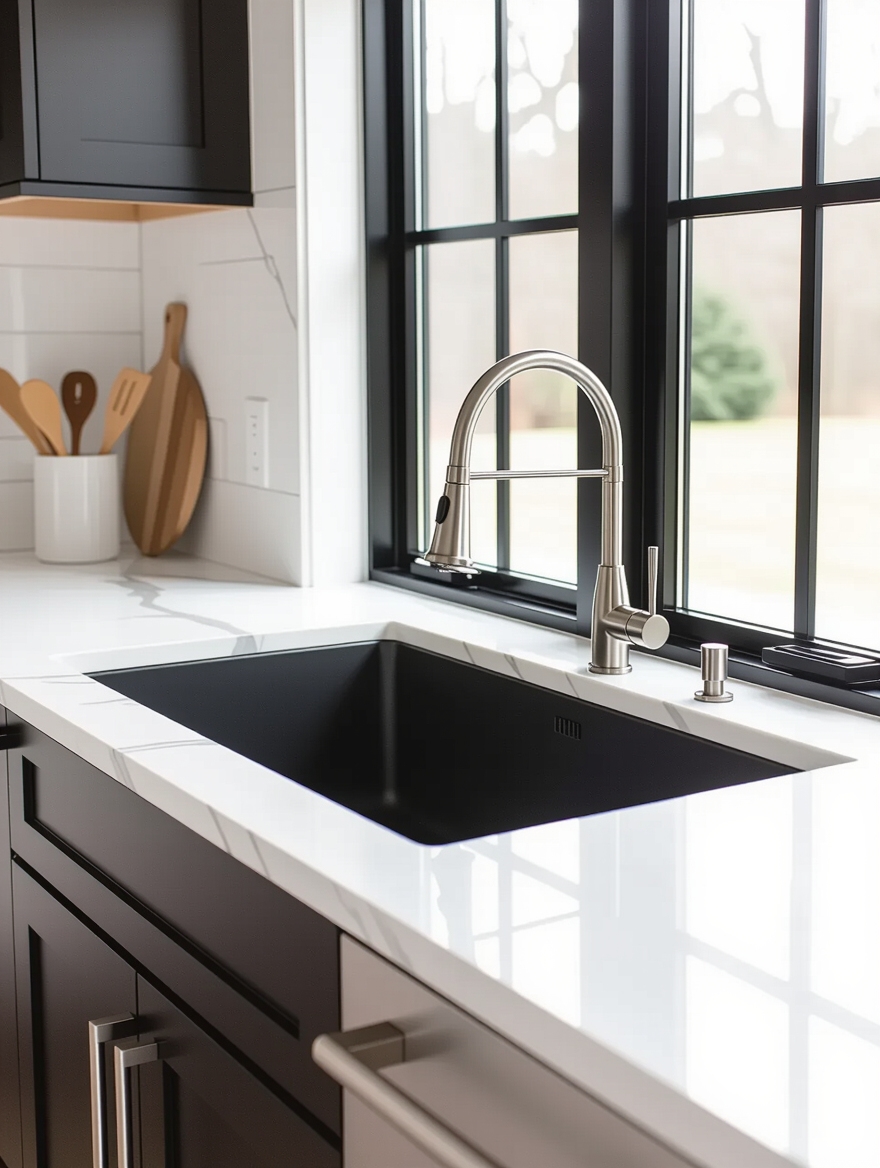
The single large bowl has overtaken the divided sink in modern kitchens. For most cooks it is the smarter call. One wide, deep basin fits a baking sheet, a roasting pan, or a cooling rack flat. A divided sink fights all three. If you run a dishwasher and mostly rinse and load, the single bowl is all the division you need.
It also reads cleaner and more spacious, which suits the pared-back modern look. The uninterrupted basin gives you the most usable washing space for the footprint, especially valuable in a smaller kitchen.
The one downside is losing the second bowl for soaking or drying, so if you hand-wash a lot you give up a handy separation. A removable colander or drying rack on a ledge gets most of that back, which is why workstation single bowls have taken off.
| Material | Rough cost | Best for |
|---|---|---|
| Stainless steel | $150 to $400 | Tough, affordable, impossible to date |
| Composite granite | $250 to $600 | Matte color that hides scratches and spots |
| Fireclay (apron) | $400 to $900 | Classic farmhouse charm, deep basin |
The Versatile Double-Bowl Sink

The double bowl still earns its keep for households that hand-wash, since it lets you soak in one side and rinse or drain in the other without juggling. Modern versions improve the format with a low divider, so you can still lay a long pan across the top, or an offset layout that gives one large bowl and one small prep basin. It is the most flexible pick for a busy, multi-cook kitchen.
- Choose a low-divide double bowl so big pans still fit across the top
- Consider an offset layout, one large bowl and one small, for prep plus washing
- Skip the even 50-50 split if you wash large cookware, since neither side fits a sheet pan
Stylish Minimalist Sink Lines

Modern sink design has moved toward crisp, minimalist geometry: tight inner corners, flat bottoms, and clean straight sides instead of the soft, rounded basins of older kitchens. The squared shape looks architectural and, as a bonus, gives you more usable basin volume in the same opening. It is the detail that quietly marks a sink as current.
Square corners hold more than rounded ones
These tight corners ask for a little more cleaning attention, since grime can gather where the walls meet, but a quick scrub keeps them sharp. The payoff is a sink that looks intentional and holds more than its rounded predecessor.
Pair the minimalist basin with a single-hole faucet and an integrated or hidden drain control for the cleanest face. The fewer interruptions on the deck, the more modern and calm the whole sink zone looks.
Essential Kitchen Sink Accessories
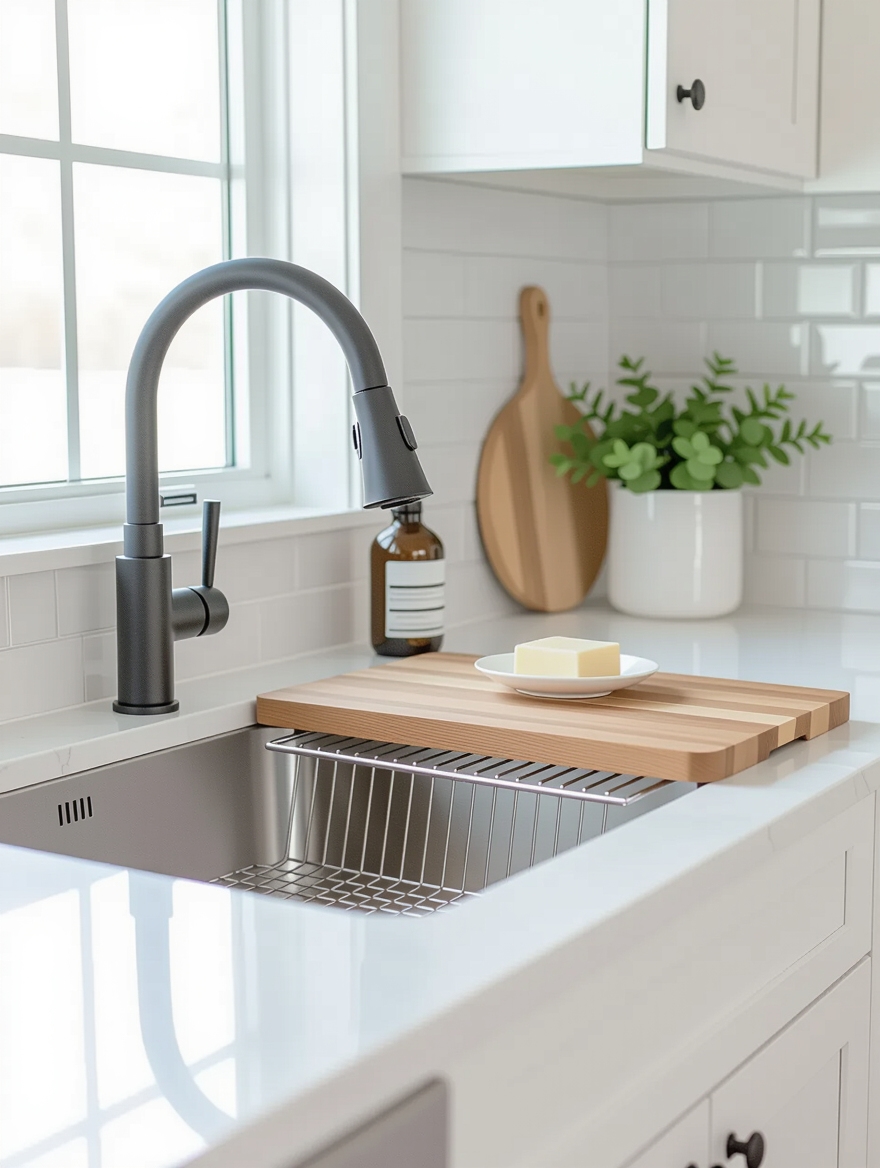
Modern sinks increasingly come as systems, with accessories that drop onto a built-in ledge to multiply what the basin does. A fitted cutting board, a colander, a drying rack, and a bottom grid turn a single bowl into a full prep station. Buying a sink designed for these accessories is what makes the difference, since they fit the exact ledge.
- Look for a workstation sink with a ledge if you want board-and-colander accessories to fit
- Add a bottom grid, around $25 to $60 and a two-second drop-in, to protect the basin from pots and knives
- Choose accessories in matching material so the system looks designed, not added on
Smart, Hygienic Kitchen Convenience

Modern sink zones increasingly build in convenience and hygiene: a touchless or pull-down faucet, an instant hot-water tap, and a built-in filtered-water spout that all reduce clutter and contact. These features make the most-used spot in the kitchen cleaner and quicker, which is where smart spending actually pays off day to day.
Be selective rather than loading up on every option, since each tap and gadget adds cost, a hole in the counter, and something that can fail. Pick the one or two you will truly use, and have any wiring or extra plumbing handled by a licensed pro. For the full rundown of these add-ons, our sink upgrade guide goes deeper.
What to Ask Before You Buy a Sink
Before you order, run through the questions that prevent expensive regret. Measure your cabinet to know the largest bowl that fits, decide undermount or drop-in based on your counter, and be honest about whether you hand-wash or rely on a dishwasher, since that settles single versus double. Match the material to your tolerance for upkeep, and confirm the faucet hole count lines up.
Then factor the install. Swapping sink size or going undermount usually means countertop and plumbing work for a pro, often half a day or more, while a like-for-like drop-in is a couple of hours for a confident DIYer. Pick the basin that fits how you actually cook first, then choose the finish you love among the options that pass.
For a sink that doubles as a showpiece, our focal-point sink ideas are worth a look, and our budget remodel moves show where a faucet-and-sink swap fits a tight budget.
Pick the Basin That Survives Your Kitchen
A modern sink blends form and function only when you choose the basin for how you cook first and the finish second. Match the material to your upkeep, the mounting to your counter, and the bowl layout to whether you hand-wash, and the sink will look sharp and work hard for a decade or more.
So measure your cabinet, be honest about how you wash up, and shop the survivors that fit before you fall for a color. Bookmark this, narrow it to two or three real options, and you will land on a sink you are glad to stand at every single day.
More to Explore


