

A galley kitchen has one real problem: two walls close together, with a narrow strip of floor between them. Done wrong, it feels like a hallway you happen to cook in. Done right, the same footprint reads bright, open, and surprisingly roomy.
The good news is that most of the fixes are visual, not structural. Light, color, reflection, and smart vertical storage can make a tight galley feel twice its size without moving a single wall. Here are the ideas that open up a narrow galley, most of them an afternoon’s work.
Making a Galley Feel Wide Open
- Most galley fixes are visual: light, pale color, and reflection make a narrow run feel far wider with no structural work.
- Store up and out of sight, ceiling-height cabinets, pull-outs, and a tall pantry, so the counters stay clear and the floor stays open.
- Keep it bright and simple; a dark, cluttered galley always feels like a hallway, while a light, edited one feels like a room.
Light Colors That Expand the Space
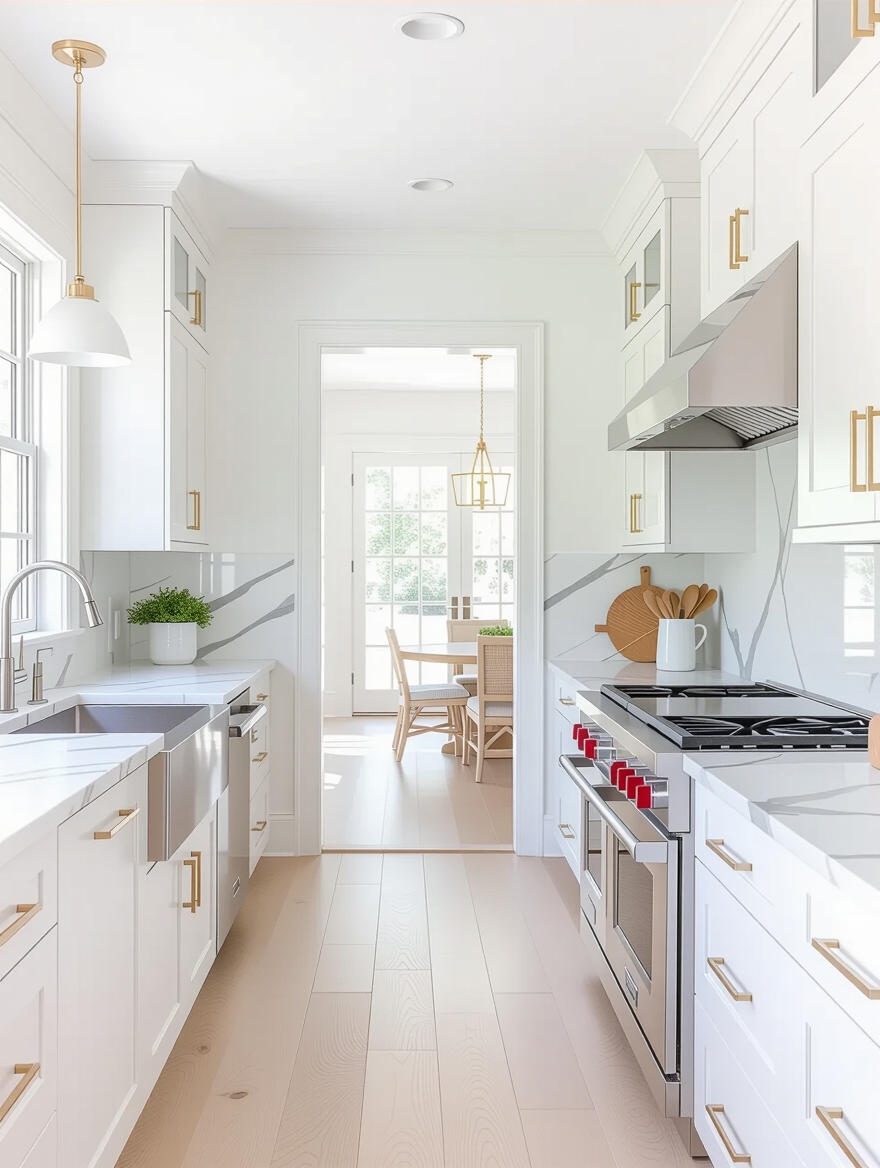
Color is the cheapest way to widen a galley, and pale shades do the heavy lifting. Pale wins here. White, soft cream, pale gray, and barely-there blue or green bounce light from wall to wall and blur the boundary between cabinet, counter, and wall, since the lighter the run, the less the eye registers where the walls actually are.
Paint the upper cabinets and walls the same light tone so the eye does not stop at a hard line, which is what makes a narrow room feel boxed in. Save any darker color for the lower cabinets or the floor, where it grounds the space without closing it in. The small-kitchen layout tricks designers use almost always start with a pale palette.
Brighten a Narrow Kitchen

A galley is often the darkest room in the house, sandwiched between walls with little window space. Brightening it is the single biggest move toward feeling open.
Light Is Free Square Footage
Maximize whatever natural light you have. Keep window treatments sheer or gone, paint the trim white to reflect light, and use a satin paint that bounces it around. A dark galley feels narrow no matter how you arrange it.
I tell people to treat light as square footage. Every lumen you add makes the walls feel further apart, so layer it generously: overhead, under-cabinet, and into the corners.
ℹ️Good to Know
Under-cabinet lighting is the highest-impact upgrade in a galley. A warm LED strip washing the counter erases the shadow line where the uppers meet the backsplash, which is exactly the line that makes a narrow kitchen feel cramped, for under fifty dollars and an hour’s work.
Transform the Kitchen With Lighting

Beyond brightness, the type and placement of light changes how big a galley feels. A single ceiling fixture casts shadows that shrink the room, while layered light opens it up.
Run recessed lights down the center of the ceiling, add a pair of slim pendants if there is a peninsula, and wash the counters with under-cabinet strips. Put it all on dimmers so the same narrow kitchen can be bright for cooking and soft in the evening. Most of these light fixes take an hour, not a renovation.
- Run recessed lights down the center line of the ceiling.
- Add under-cabinet strips to erase the dark counter shadow.
- Put every layer on a dimmer for flexible, even light.
Mirrors for Instant Spaciousness

A mirror is the oldest trick for faking space, and it works beautifully in a galley. A mirrored backsplash, a framed mirror at the end of the run, or a high-gloss reflective tile doubles the visual depth of the room.
I love a mirror or a reflective splash at the far end of a galley, since it tricks the eye into reading the room as longer and wider than it is. If a full mirror feels like too much, a polished metal backsplash or glossy subway tile gives a softer version of the same bounce. The small-kitchen decor hacks lean on reflection for exactly this reason.
What is making your galley feel cramped?
1It feels dark and shadowy
Add light, under-cabinet strips, white trim, and a satin paint that bounces it around.
2It feels cluttered and tight
Go vertical and hidden: tall cabinets, pull-outs, and clear counters open it up fast.
Effective Task Lighting

In a galley, task lighting does double duty. It makes the kitchen usable, and it makes it feel bigger. Because the counters are close, bright, even task light keeps the work zones from falling into shadow.
Light every counter run, both sides if it is a double galley, and the sink and cooktop especially. Even, shadow-free counters read as open and orderly, while a half-lit galley feels narrow and cave-like. Choose warm bulbs so the light flatters and does not glare.
- Light both counter runs, not just the main one.
- Add focused light over the sink and cooktop.
- Keep bulbs warm so the light feels soft, not clinical.
Vertical Storage With Cabinets

When floor space is fixed, the only direction left is up, and a galley rewards vertical storage more than any other layout. Run the cabinets to the ceiling, add a tall pantry cabinet at one end, and use the full height of every wall. Tall cabinets draw the eye up and store more in the same footprint, which clears the counters and the floor.
The reward is a galley that holds a full kitchen’s worth of gear without feeling packed. Height is the galley’s hidden acre. Stack a plate rack or a row of open shelves above the uppers if the ceiling allows, and use stepped storage so the tallest, least-used items sit up where you rarely reach anyway.
- Extend wall cabinets all the way to the ceiling.
- Add a floor-to-ceiling pantry at one end of the run.
- Use the top shelves for the things you reach for least.
Add vertical storage in order of payoff:
1Take the uppers to the ceiling
Close the dead gap above the cabinets for a foot of extra storage and a taller-looking room.
2Add a tall end cabinet
A floor-to-ceiling pantry at one end stores dry goods and small appliances out of sight.
3Hang a rail or magnetic strip
Free the counters by moving utensils and knives onto the wall between the uppers and the counter.
Open Up Space With Shelving

Swapping a run of upper cabinets for open shelves makes a galley breathe. Without the bulk of closed cabinet boxes, the walls feel further back and the room feels less boxed in.
Use open shelves on one wall and keep closed cabinets on the other for storage balance, and style the shelves lightly so they read as space, not clutter. A galley with one open wall instantly feels wider. The double-space small-kitchen tricks often swap a few uppers for shelves to lift the ceiling line.
- Replace some upper cabinets with open shelves on one wall.
- Keep the opposite wall closed for hidden storage.
- Style shelves sparsely so they feel open, not crowded.
Maximize Storage in a Galley

A galley lives or dies by storage, since clutter on the counters instantly makes the narrow space feel narrower. The fix is to give everything a home inside the cabinets: drawer dividers, pull-out shelves, a deep pantry pull-out, and toe-kick drawers all squeeze storage from space that usually goes to waste.
Clear counters are the single biggest thing that makes a galley feel open, so every item you store out of sight buys back visual room. Edit ruthlessly. Most galleys hold twice the gear they need, so a hard pass through every cabinet, donating the duplicate sheet pan and the gadget you have not touched in a year, frees up real storage before you buy a single organizer.
- Add pull-out shelves and drawer dividers inside the cabinets.
- Use toe-kick drawers and corner pull-outs for dead space.
- Aim to keep the counters almost completely clear.
Clever Storage Solutions

The narrowest galleys win with clever, space-stealing storage a bigger kitchen never bothers with. A slim pull-out pantry between the fridge and the wall, a hanging rail for utensils, magnetic knife strips, and over-sink shelving all reclaim inches you did not know you had.
I recommend a slim rolling cart that tucks into a gap and pulls out when you need extra counter, since a galley rarely has room for an island but can usually spare four inches. A narrow cart runs about $40 to $120, far less than any built-in. The maximize-every-inch ideas are full of these narrow-gap tricks.
Open, Stylish Glass Storage

Glass-front cabinets are a quiet way to make a galley feel less heavy. The glass lets the eye travel into the cabinet instead of stopping at a solid door, which makes the wall feel deeper and lighter.
Use glass fronts on the uppers, light the inside, and the cabinets almost disappear into the wall. Keep what is behind the glass tidy and pale, white dishes, clear glasses, so it reads as airy. A few glass fronts break up a solid wall of cabinetry and keep a galley from feeling like a corridor of doors.
Mix solid and glass. A whole run of glass can feel busy, so alternate a few glass doors with solid ones, or glass only the cabinets flanking a window, and the wall stays calm while still reading lighter.
Common Mistakes to Avoid
The biggest galley mistake is treating it like a bigger kitchen and crowding the counters with appliances and decor. In a narrow run, every object on the counter steals visual width, so the rule is strict: if it is not used daily, it lives in a cabinet.
The other mistake is going too dark or too busy. I see galleys ruined more by a loud patterned floor and heavy curtains than by their actual size. Keep the palette light, the counters clear, and the lines simple, and a narrow galley reads open instead of tight.
More Galley Kitchen Questions
?How do you make a galley kitchen look bigger?
Light and pale color do the most. Keep walls and uppers a light tone, brighten with layered and under-cabinet lighting, add a mirror or glossy backsplash for reflection, and clear the counters. Together these make a narrow run feel far wider without moving a wall.
?What is the best color for a small galley kitchen?
Light, cool-to-neutral tones: white, soft gray, pale greige, or a barely-there blue or green. Painting the walls and upper cabinets the same pale color blurs the boundaries and makes the space feel open. Save darker shades for the lower cabinets or the floor.
?How do I get more storage in a galley kitchen?
Go vertical and hidden. Run cabinets to the ceiling, add a tall end pantry, and fit pull-outs, drawer dividers, and toe-kick drawers inside. Move utensils onto wall rails to free the counters, since clear counters are what keep a galley feeling open.
A Galley That Lives Larger
A narrow galley does not have to feel like a squeeze. Light it well, keep the palette pale, add a mirror or some glass, and send the storage up the walls and out of sight, and the same tight footprint starts to feel like an efficient, open little kitchen.
Pick the thing that bothers you most, the dark corner, the cluttered counter, the heavy cabinets, and fix that first. A galley rewards every visual trick you give it, and most of them cost far less than the wall you were tempted to knock down.
More Hair Ideas


