

What do you get when Japanese restraint marries Scandinavian warmth? A kitchen that feels calm without feeling cold, which is the whole promise of Japandi. It takes the clean lines and quiet of Japanese design and softens them with the cozy, woody comfort of Scandi style, landing on a space that is minimal yet still warm.
These nineteen elements are how you build that serenity, from the natural materials to the empty counter to the single plant. Most are about subtraction and care rather than spending, so Japandi is a style you can move toward gradually, one calm choice at a time. I have noted where each element comes from and how to bring it home.
The Two Halves of Japandi
| From Japanese design | From Scandinavian design | Together |
|---|---|---|
| Restraint and empty space | Cozy warmth and function | Calm but not cold |
| Wabi-sabi, beauty in imperfection | Hygge, everyday comfort | Natural, lived-with serenity |
| Dark woods, low lines | Pale woods, soft light | A balanced, warm-neutral palette |
Where Japandi Minimalism Meets Comfort

The heart of Japandi is a balance most minimalism misses: spare yet still warm. Japanese design brings the discipline, the empty surfaces, the clean lines, the sense of calm, while Scandinavian design brings the warmth that keeps all that restraint from feeling like a showroom. The result is a kitchen that feels both ordered and welcoming.
Quiet Plus Warmth
That balance is the thing to hold onto as you make choices. Every Japandi element below leans one way or the other, toward Japanese quiet or Scandi comfort, and the skill is keeping the two in conversation. Too much restraint and the kitchen goes cold; too much coziness and it loses the serenity.
The good news is that the balance is forgiving and gradual. You do not renovate your way to Japandi; you edit and warm your way there, removing what is loud and adding what is natural, until the room feels quiet and kind at once. It is more a discipline than a budget.
Warm, Textured Natural Wood

If Japandi has one essential material, it is natural wood, and the warmth of it is what separates this style from cold minimalism. Wood appears everywhere in a Japandi kitchen, on cabinets, shelves, counters, stools, in tones that lean either pale Scandi or deeper Japanese, but always matte and natural. It is the element that makes the whole room feel grounded.
A few choices keep the wood true to the style.
- Choose matte, natural finishes over high-gloss or heavy stain, so the grain and texture show.
- Let small imperfections show, since wabi-sabi finds beauty in the natural and the worn.
- Keep the wood tones in one family for calm, whether you lean pale or deep. See wood cabinets that feel fresh.
| Element | Japanese lean | Scandinavian lean |
|---|---|---|
| Wood tone | Deeper, darker woods | Pale, light woods |
| Mood | Spare, contemplative | Cozy, functional |
| Guiding idea | Wabi-sabi, imperfect beauty | Hygge, everyday comfort |
| Lighting | Restrained, shadowy | Soft, warm, layered |
Minimalist Japandi Kitchen Design

The bones of a Japandi kitchen are quietly minimalist: simple cabinet fronts, hidden or slim hardware, and a tight, uncluttered layout. The aim is for the eye to find rest, so the design works hard to hide the busywork of a kitchen behind calm, clean surfaces. Here is how to get those minimalist bones right.
- Use flat or shaker fronts with recessed or push-to-open hardware so the cabinet faces stay calm.
- Plan generous hidden storage, since the serenity depends on keeping things out of sight.
- Keep the lines low and horizontal where you can, echoing the grounded feel of Japanese design.
Warm Neutrals for Serene Kitchens

Color in a Japandi kitchen is quiet by design, built from warm neutrals and soft, earthy tones that soothe the eye. Think warm whites, soft greiges, muted clay, pale wood, and the occasional charcoal or muted green for depth. The palette is restrained, but the warmth in it keeps the room from going stark.
Keep the palette tight and warm.
- Build on warm whites and greige, which hold the warmth; cool grays can chill the serenity.
- Add depth with one muted accent, charcoal, clay, or a soft green, used sparingly.
- Let the wood tones carry much of the color, so the painted surfaces can stay quiet. See green as a calm neutral.
A few Japandi terms worth knowing.
📖Wabi-sabi
The Japanese idea of finding beauty in imperfection and impermanence. In a kitchen, it means embracing natural marks and patina instead of chasing perfection.
📖Hygge
The Scandinavian sense of cozy, contented everyday comfort. It is the warmth, soft light, and natural texture that keep Japandi from feeling cold.
📖Ma
The Japanese appreciation of empty space, the pause between things. It is why a Japandi shelf or counter leaves so much deliberate room around each object.
Minimalist Open Shelving

Open shelving suits Japandi beautifully, but only when it is styled with the same restraint as everything else. A few wood or simple ceramic pieces, arranged with plenty of empty space around them, turn a shelf into a small, calm composition. The space between the objects matters as much as the objects.
The discipline is in leaving room. Show only the pieces you find beautiful or use daily, group them loosely, and resist filling every inch, since the emptiness is the point. A single wood bowl with breathing room around it is more Japandi than a shelf packed with pretty things, however lovely each one is on its own.
Matte Finishes for Quiet Elegance

Japandi turns away from shine almost everywhere, and the matte finish is a big part of why these kitchens feel so calm. Glossy surfaces bounce light and draw the eye; matte ones absorb it and let it rest, which is exactly the mood Japandi is after. From cabinets to hardware to counters, the surfaces stay soft and low-sheen.
Soft Light, Not Glare
This shows up in every material choice. Matte-painted or natural wood cabinets, honed rather than polished stone, brushed or blackened metal, and unlacquered, low-shine hardware all push the room toward quiet. The absence of glare is something you feel more than notice.
Matte has a practical upside in a kitchen, too. Low-sheen surfaces hide fingerprints and water spots better than gloss, so the serene look also stays looking serene with less wiping, which suits the calm, low-fuss spirit of the whole style.
“If you are planning a Japandi kitchen with a designer or contractor, ask these: Can we integrate the fridge and dishwasher behind cabinet panels, or at least choose matte finishes? Where can we add hidden storage so the counters stay clear? Can the lighting be warm and on dimmers rather than one bright overhead? And can we keep the wood tones and finishes matte and in one family? Those four answers shape most of the serenity.”
Functional, Clutter-Free Surfaces
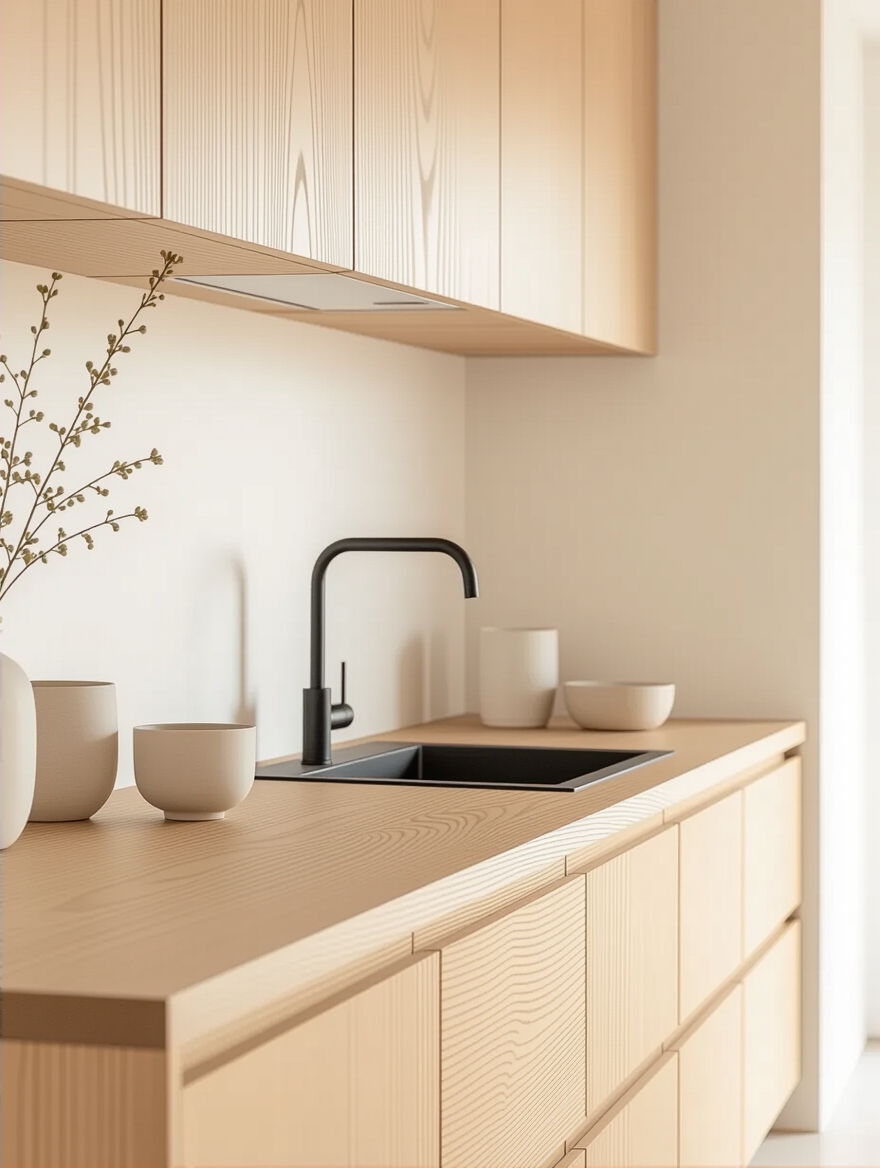
Nothing says Japandi like a clear counter, and nothing undoes it faster than clutter. The empty surface is not just an aesthetic; it is the visual quiet the whole style depends on, so a Japandi kitchen is designed to give everything a home out of sight. Here is how to win the daily battle with the counter.
- Build in enough storage that the things living on counters, the toaster, the mail, the gadgets, get a home.
- Keep out only what you use every single day, and even then, choose pieces worth looking at.
- Make a habit of a quick reset; a two-minute counter clear each night keeps the serenity intact.
Integrated, Hidden Kitchen Appliances

Visible appliances are visual noise, and Japandi quiets them by tucking them away. Integrated, panel-front appliances and concealed small-appliance storage keep the stainless and the buttons from interrupting the calm wood-and-neutral palette. It is one of the more involved elements, but it does the most to hold the serenity. Here is how to approach it.
- Use panel-ready fridges and dishwashers that wear a cabinet front, so they vanish into the run.
- Add an appliance garage or a deep pantry pullout to hide the toaster, kettle, and blender.
- If integration is out of budget, choose matte or muted appliance finishes over shiny stainless to soften the noise.
Soft, Warm, Inviting Lighting

Lighting is where the Scandinavian half of Japandi shines, because the Scandi love of cozy, low light is exactly what keeps a minimal kitchen warm. Hard, bright, overhead light would undo all the calm, so Japandi leans on soft, warm, layered light that pools gently. The glow is half the serenity.
Layer It Warm and Low
Layering is the technique. A warm overhead source for tasks, under-cabinet light for the counter, and a low pendant or a small lamp for evening glow give you light at different heights and moods, all on the warm end of the scale. Put it on dimmers so the kitchen can soften into the evening.
Choose fixtures that fit the quiet aesthetic, too. Paper or linen shades, simple wood or blackened-metal pendants, and warm bulbs around 2700K keep the lighting itself part of the calm, natural palette.
Easy-Care Plants for the Kitchen

A touch of green is the final, living element of a Japandi kitchen, and it ties the whole nature-loving philosophy together. One or two simple, sculptural plants bring life and a breath of the outdoors into the calm space, in keeping with both the Japanese and Scandinavian reverence for the natural. The key, as always, is restraint. Here is how to choose them.
- Pick one or two sculptural plants, a small bonsai-style tree, a single trailing pothos, kept simple.
- Choose easy-care, forgiving plants so the calm is not undone by fussing over them.
- Pot them in simple matte ceramic or wood in muted tones, so the container fits the palette.
Maintenance & Care
The beautiful thing about Japandi is that its upkeep is built into the philosophy: the style asks for the same calm, mindful care that defines it. The biggest maintenance habit is simply the daily reset, a two-minute counter clear and a quick wipe each evening, which keeps the empty surfaces that make the look work.
Natural wood and matte finishes ask for gentle care, mild soap, a soft cloth, the occasional re-oiling of a butcher block every month or two, and they reward it by aging gracefully.
Lean into wabi-sabi rather than fighting it. A few soft marks on a wood counter, a little patina on the brass, the gentle wear of a well-used kitchen, are part of the beauty in this style, so you are spared the anxious upkeep a high-gloss, perfect-finish kitchen demands.
Keep the palette warm, the surfaces matte, and the counters clear, and a Japandi kitchen stays serene with less effort than almost any other style. For the warming touches that finish it, see kitchen staples that add warmth.
Japandi Kitchen Questions, Answered
?What exactly is a Japandi kitchen?
It is a kitchen that blends Japanese minimalism with Scandinavian warmth. From the Japanese side it takes clean lines, empty space, and calm restraint; from the Scandinavian side it takes cozy comfort, natural wood, and soft light. The result is a space that feels minimal and serene, yet warm and welcoming.
?How do I make my kitchen feel Japandi on a budget?
Start by subtracting, since Japandi is more about editing than buying. Clear the counters, swap to warm bulbs, and add a single sculptural plant, all nearly free. Then, over time, lean into matte finishes, natural wood tones, and a warm-neutral palette as you replace things. The calm comes from restraint and warmth, not from spending.
?What colors work in a Japandi kitchen?
Warm neutrals and soft, earthy tones: warm whites, greige, muted clay, and plenty of natural wood, with the occasional charcoal or muted green for depth. Avoid cool grays and bright, saturated colors, which break the calm. Let the wood carry much of the color so the painted surfaces can stay quiet and restful.
?Is Japandi the same as minimalism?
Not quite. Pure minimalism can feel cold and stark, all white and empty. Japandi keeps the minimalism’s clean lines and uncluttered surfaces but adds warmth through natural wood, soft light, cozy texture, and the wabi-sabi acceptance of imperfection. Think of it as minimalism with a heart, which is exactly why so many people find it more livable.
?Does a Japandi kitchen need a lot of upkeep?
Less than most styles, actually. Its philosophy embraces natural wear and patina through wabi-sabi, so you are not chasing perfection. The main habit is keeping counters clear with a quick daily reset, plus gentle care of wood and matte surfaces. Because it favors matte over gloss, it even hides fingerprints and water spots better than a shiny kitchen.
Edit Your Way to Calm
Japandi is less a shopping list than a way of editing, and that is what makes it reachable on any budget. You move toward it by removing what is loud and shiny and cluttered, then warming what remains with natural wood, soft light, and a single living thing. The Japanese half keeps it quiet, the Scandinavian half keeps it kind, and the balance between them is the serenity everyone is after.
Start with the easiest, cheapest element, a cleared counter and a warmer bulb, and feel how much calmer the room gets before you change anything bigger. Which loud thing in your kitchen would you quiet first?
More Looks We Love


