

Open the cabinets in a truly organized kitchen and the calm is no accident: every pot, lid, and spice jar has a dedicated home it returns to without a fight. That is the difference between a kitchen that looks tidy for a photo and one that stays tidy for years, and it comes from the storage components built into it, not from willpower.
Below is the toolkit of storage pieces that an organized kitchen leans on, the adjustable shelves, dividers, corner units, and pantry systems that give everything a place. Each comes with the rough cost and the honest catch, so you can build the system one cabinet at a time. Start with the spot that frustrates you most and work outward from there.
The Organized-Kitchen Toolkit
An organized kitchen is built, not maintained by sheer effort. The components that do the work are adjustable shelves that fit your real items, drawer and vertical dividers that stop the jumble, corner and under-sink solutions that reclaim dead space, and clear, labeled pantry storage that keeps food visible. Together they give every item one home.
Most of these cost under $30 a cabinet and install with no tools, so you can build the system gradually rather than in one expensive weekend. The trick is tuning each piece to what you actually own and how you cook, then the kitchen stays organized because the storage matches the habit.
Adjustable Shelves That Enhance Organization

The first piece of an organized kitchen is shelving that fits your real things, since most cabinets ship with shelves spaced for some imaginary average dish. That leaves a band of dead air above your shorter items and forces precarious stacking everywhere else. Adjustable shelves fix it by letting you set the height to mugs on one level and cereal boxes on another.
Many cabinets already have the peg holes, so this can be a free afternoon of resetting rather than a purchase. Where they do not, an adjustable shelf system or a cheap wire riser, around $12, splits a too-tall shelf into two usable levels. Either way, you reclaim a whole band of wasted vertical space.
Pull everything out and group by height before you reset, so you space the shelves to what you actually own. I tell clients this five-minute step does more than any new cabinet. Keep the heaviest items low for safety, and you turn a half-empty cabinet into one that holds far more without a single new box.
Vertical Dividers for Organization

Stacking flat items, baking sheets, cutting boards, pot lids, trays, is how cabinets become an avalanche, since the one you need is always at the bottom of the pile. Vertical dividers solve it by standing each piece on its edge, so a tray or board slides straight out on its own. It is one of the most satisfying upgrades in the whole kitchen, and our small-kitchen organization plan leans on it hard.
Use them in a tall, narrow cabinet beside the oven for trays and boards, and add a smaller rack for lids so they stop sliding around the cabinet floor. A tension-rod divider does the job for a few dollars where a dedicated rack will not fit.
- Stand trays, boards, and lids upright in a wire file rack so each pulls out alone
- Use a slim cabinet beside the oven as a dedicated upright slot for bakeware
- Improvise with tension rods, a few dollars, where a fitted divider will not fit
An organized kitchen is not the work of a tidy person. It is the work of good storage, where every item has one home it returns to without a fight.
Efficient Kitchen Drawer Organization

Drawers are where an organized kitchen is won or lost, since a divided drawer is the difference between scanning and digging. Drawer dividers, adjustable trays, or simple spring-loaded inserts give every category its own lane, so spoons, knives, and gadgets stop tangling. A basic set runs about $10 to $25 and the spring-loaded kind installs in seconds.
One slot per category
The principle that keeps a drawer organized is one slot per category, with the daily-use lane front and center where your hand lands. Deep drawers beat low cabinets for almost everything heavy, since you pull the contents out to you instead of crawling in.
Measure the drawer’s depth and width before you buy, since the most common mistake is a tray that does not fit. Leave one lane half empty for the things that always drift in, and the system has room to breathe instead of overflowing. Our declutter-first plan covers the purge that makes any divider work.
Maximize Kitchen Cabinet Space

Deep base cabinets are where pots and small appliances go to be forgotten. Anything past the front row means kneeling and digging. Pull-out drawers and roll-out trays fix that by bringing the whole shelf out to you, so the stockpot at the back is as easy to grab as the one in front. Slide-in wire baskets cost around $20 to $40 and need no permanent install.
- Fit slide-out baskets in your deepest, lowest cabinets where the digging is worst
- Choose freestanding pull-out baskets if you rent, since they lift right out when you move
- Reserve fitted roll-outs for a renovation, where they look most built-in
A few storage terms that come up when you build the system:
📖Lazy Susan
A rotating turntable that brings the back of a deep or corner cabinet to your hand with a spin. The cheapest fix for a black-hole corner.
📖Toe-kick drawer
A shallow drawer fitted into the recessed space below base cabinets, usually wasted. Ideal for flat trays, linens, and pet bowls.
📖Decanting
Moving food out of its bag or box into a clear, airtight container. Helps visibility and freshness, but only if you keep labeling and refilling.
Reclaim Every Bit of Kitchen Space
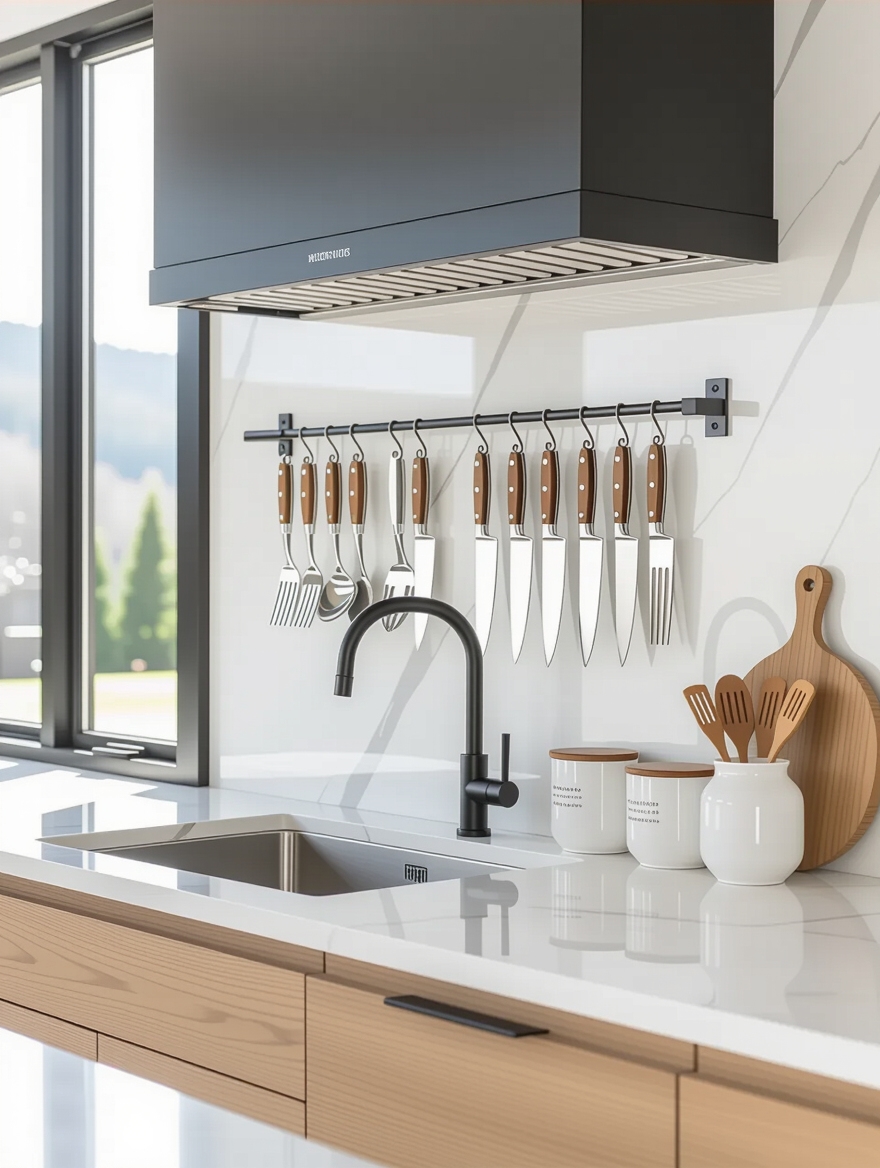
An organized kitchen wastes nothing, and the easiest wins hide in the spots most people give up on: the blind corner, the gap beside the fridge, the back of every door. A lazy Susan, around $8 to $15, turns a black-hole corner into a spin-to-reach carousel, while a slim pull-out fills a narrow gap with spice or tray storage. Reclaiming these dead zones can add a surprising amount of usable room.
- Drop a lazy Susan into a deep corner to rescue the hardest cabinet in the kitchen
- Fit a narrow pull-out into the gap beside the fridge or stove for spices or trays
- Mount over-the-door racks, about $15, to use the wasted back of every cabinet door
Maximize Hidden Kitchen Storage

The most overlooked storage in any kitchen sits under the sink and along the floor, awkward, pipe-crossed, and usually a mess. With the right inserts, even these spaces pull their weight, so an organized home leaves none of it idle. The trick is choosing fittings made to work around the obstacles.
- Use a two-tier under-sink shelf that notches around the pipes for cleaning supplies
- Add a tension rod across the under-sink cabinet to hang spray bottles by the trigger
- Fit toe-kick drawers in the dead space below base cabinets for flat trays and linens
How to build an organized kitchen, one cabinet at a time:
1Pick the worst spot
Choose the single drawer or cabinet that frustrates you most, since one solved problem motivates the next.
2Empty and purge
Pull everything out, toss the expired and duplicate, and keep only what earns its space.
3Reclaim the volume
Reset adjustable shelves, add risers, pull-outs, or a lazy Susan to use the dead air and corners.
4Divide and contain
Add drawer dividers, upright racks, and clear bins so every category has its own lane.
5Set a weekly reset
Spend ten minutes a week returning strays to their zones, and the system holds itself.
Organized Spice Storage Solutions

Spices buried in a deep cabinet get bought twice and used never. Getting them visible is the whole battle. I love a flat spice drawer for exactly this. A tiered shelf insert, a drawer laid out flat, or a door-mounted rack lets you read every label at a glance. Group them the way you cook, baking spices together and everyday savory ones up front, and cooking gets faster overnight.
Decant into matching jars only if you will keep up the labeling, since half-relabeled jars are worse than the original tins. And do a quick smell-test purge while you are in there, since ground spices fade after a year or two and a scentless jar is just taking up a good slot.
- Lay spices flat in a drawer or on a tiered insert so every label shows
- Group by how you cook, baking together, everyday savory up front
- Purge the scentless old jars, since faded spice is wasted shelf space
Fresh, Visible Pantry Organization

A pantry is the heart of an organized kitchen. The rule that keeps it working is visibility, since the food you cannot see is the food you buy twice and toss later. Keep shelves shallow enough to see the back, around 12 to 16 inches, and group everything into zones you shop from: baking, breakfast, snacks, dinner staples. Suddenly restocking is obvious.
Shallow shelves you can see beat deep ones you cannot
Front your oldest items each time you restock so nothing expires unseen, and put the daily zones at eye level with bulk and rarely-used stock up high. A pantry organized to your real routine stays tidy far longer than one arranged to look good for a day.
Add a light to any dark corner, since a pantry you cannot see is a pantry that hides expired food. Our pantry design ideas cover the layout in depth, and the visibility principle is the one I come back to most.
Organize the Pantry With Stackable Bins

I recommend clear stackable bins to turn a chaotic pantry shelf into tidy, countable columns, since their square sides use the full depth and height with no wasted gaps. Decant the staples you use most, flour, rice, pasta, cereal, into uniform airtight canisters, corral the awkward packets in labeled bins, and you both see your levels and keep pests out. Their flat sides waste none of the shelf, where bags and boxes leave gaps.
- Choose square, clear, airtight canisters so they stack tight and show what is inside
- Decant the four or five staples you use constantly first, not the whole pantry at once
- Label each bin and front the oldest stock, so nothing hides and expires at the back
Maximize Storage With Smart Cabinets

If your organizing goes as far as new cabinetry, the storage can be designed in from the start, which is where an organized kitchen reaches its peak. Tall pull-out larders, deep pot drawers instead of low cabinets, built-in dividers, and a dedicated appliance garage put a home for everything into the bones of the kitchen. You buy the organization once and live with it for decades.
- Choose deep drawers over low cabinets, since pulling contents out beats crawling in
- Build in a tall pull-out larder and a corner solution so no space is wasted from day one
- Add an appliance garage to keep the counters clear, the upgrade you feel every morning
Building a Storage System That Lasts
The secret to a kitchen that stays organized is to build the system gradually and match each piece to a real habit, rather than buying a pile of bins in one hopeful sweep. Start with the one cabinet or drawer that frustrates you most, fix it with the right component, and only then move to the next. A system added thoughtfully, one zone at a time, sticks far better than a weekend blitz that unravels by spring.
Pair the components with a small, regular reset, ten minutes a week returning strays to their zones, and the kitchen holds its calm without daily effort. Most of these pieces cost little and install with no tools, so cost is rarely the barrier; the order is. Which cabinet in your kitchen would you most like to open and finally find calm inside?
Organized-Kitchen Storage Questions People Ask
?Where do I start organizing my kitchen storage?
Start with the single cabinet or drawer that frustrates you most, not the whole kitchen. Empty it, purge the expired and duplicate, then add the right component, a divider, riser, or pull-out, before moving on. One solved spot builds the momentum to tackle the next, and the gradual approach sticks far better than a one-weekend blitz.
?What storage actually keeps a kitchen organized long term?
Components that give every item one home: adjustable shelves set to your real things, drawer dividers with one slot per category, pull-outs and a lazy Susan for deep and corner cabinets, and clear, visible pantry storage. Pair them with a ten-minute weekly reset, since the system holds only when straying items get returned regularly.
?How much does it cost to organize a kitchen’s storage?
Less than most people expect. Drawer dividers run about $10 to $25, a lazy Susan $8 to $15, slide-out baskets $20 to $40, and a wire shelf riser around $12, most needing no tools. Because you build the system one cabinet at a time, the cost spreads out, and the real barrier is usually order, not money.
Give Everything One Home, One Cabinet at a Time
An organized kitchen comes down to a simple idea built into the storage: every item has one home it returns to easily. Adjustable shelves, dividers, corner and under-sink solutions, and clear, visible pantry storage are the components that make that possible, and most cost little and need no tools to fit.
So do not try to organize the whole kitchen at once. Pick the cabinet that bothers you most, give its contents a real home with the right piece, and let one fixed spot lead you to the next. Build it gradually, add a ten-minute weekly reset, and the calm you see in an organized kitchen becomes yours to keep.
More Looks We Love


