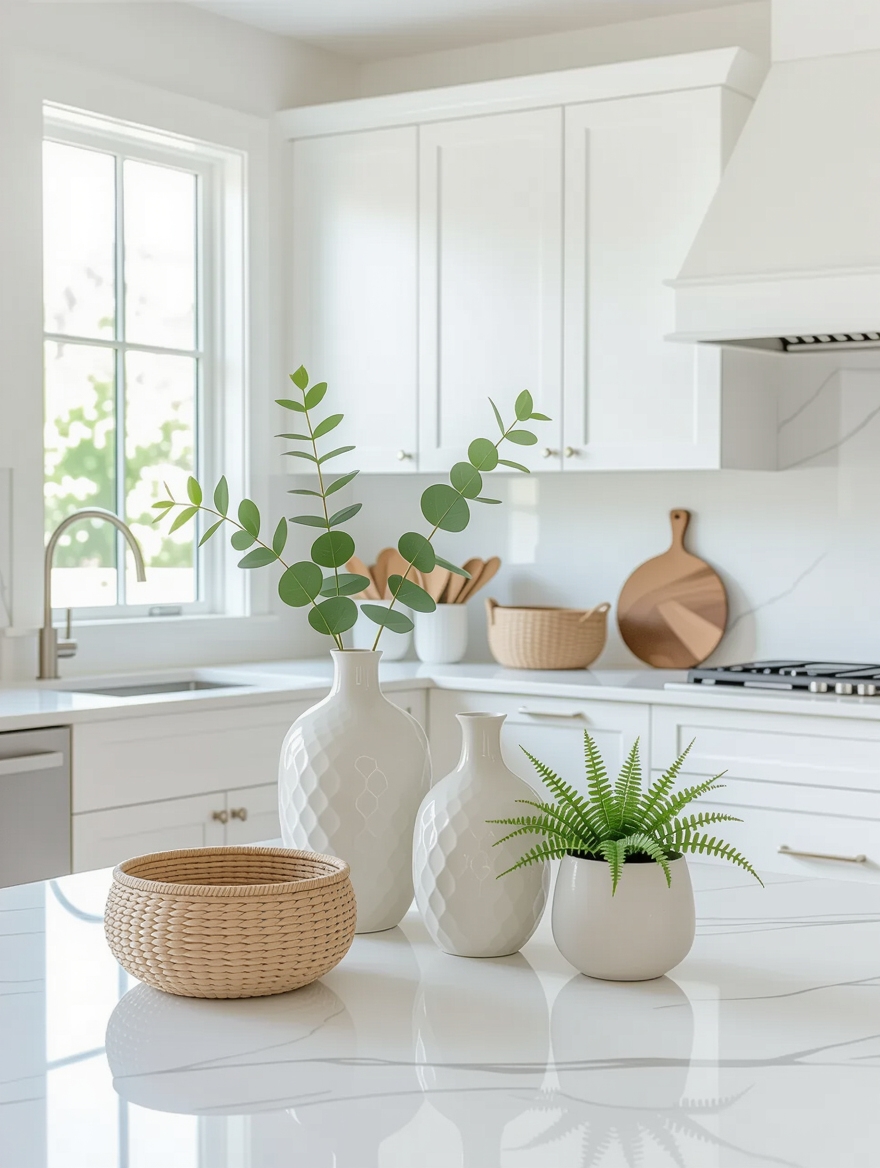

Walk into a lot of open-plan homes and you can feel the seam: a kitchen that was decorated by one set of rules and a living room decorated by another, sharing a floor but not a single idea. The fix is not matching everything. It is giving the two zones enough in common that the eye reads them as one space while still letting each do its job.
These twenty ideas are the threads that stitch a living room and kitchen together, color, flooring, lighting, furniture, and the way you zone the room. I have noted which are quick weekend swaps and which take more planning, so you can start wherever your budget and patience allow and build the flow one decision at a time.
How Flow Actually Works
Cohesion comes from repetition. Repeat a few colors, materials, and metals across both zones and the eye links them, even when the furniture and function are completely different. You do not need a single shared palette so much as a shared thread.
The biggest levers are the ones that run through both spaces at once: continuous flooring, a consistent wall color, and lighting at a matching temperature. Get those right, then use rugs and furniture to define each zone within the larger, connected room.
Start With a Unified Color Scheme

The single most powerful flow tool is a shared color story, and it is the place to start before you buy a thing. You do not need every surface to match; you need a small palette, say three or four colors, that shows up in both zones so the eye keeps finding familiar notes as it travels across the room.
The trick is in how you distribute those colors across the space.
- Pick one main neutral plus one or two accents and use them in both spaces, in different proportions.
- Let the kitchen carry more of the neutral and the living room carry more of the accent, or the reverse.
- Repeat one bold color, a green, a navy, a terracotta, in both zones so the link feels deliberate.
Build a Cohesive Living and Kitchen Design

Cohesion is about a shared design language across different furniture. The kitchen and living room should feel like they were decorated by the same person with the same taste, even though they hold completely different things. Here is how to set that shared language.
- Choose one overall style, modern, farmhouse, transitional, and let both zones speak it, so nothing feels grafted on.
- Repeat a material across the divide, the kitchen’s wood counter echoed in a living-room shelf or coffee table.
- Keep your metals consistent, all warm or all cool, since mismatched hardware and lighting break the spell fastest.
ℹ️Good to Know
Designers often work to a loose rule of three for open-plan cohesion: repeat at least three elements across both zones, usually a color, a material, and a metal finish. Below three repeated threads, the rooms tend to read as separate; at three or more, the eye reliably links them as one space. It is a simple checklist you can run before you buy anything, and it keeps cohesion from being guesswork.
Complementary Wall Textures That Enhance Flow
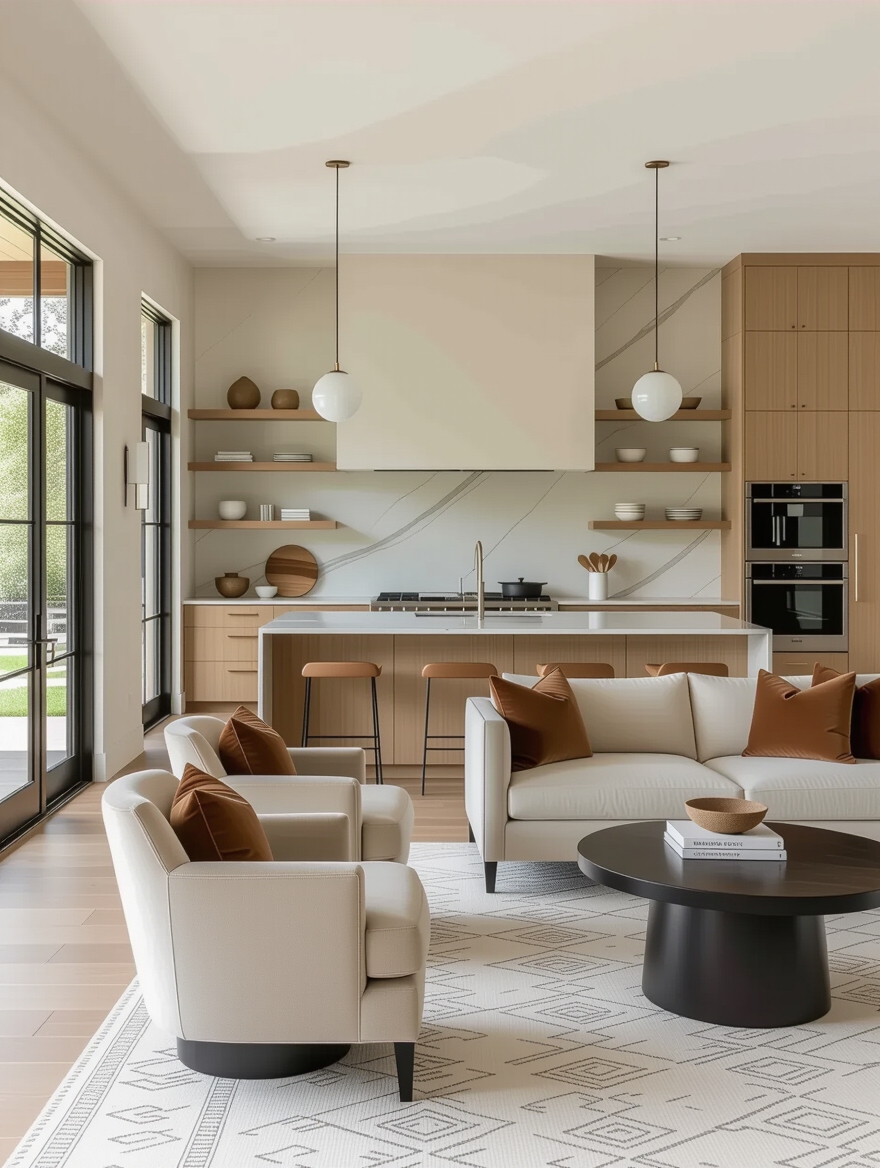
Texture is the quiet way to connect two zones when you do not want them painted the same color. A material that appears in both rooms ties them together at a level the eye feels more than notices, which is exactly the kind of subtle link that makes a space feel designed. Here is where to repeat texture.
- Carry one wall treatment across the divide, board-and-batten, shiplap, or a limewash finish, into both zones.
- Echo a kitchen backsplash texture in a living-room accent, like a stone fireplace or a textured planter.
- Keep the textures in the same family so they feel related and calm together.
Cohesive Furniture and Design Choices

Furniture is where flow most often breaks down, because people buy living-room pieces and kitchen stools on separate trips with separate moods. The fix is to shop for the open space as a whole, looking for pieces that share a wood tone, a line, or a finish even when they serve different rooms.
A few habits keep the furniture conversation consistent.
- Match the wood tone of your dining chairs, bar stools, and coffee table so they read as a set across the room.
- Repeat one shape, all rounded or all squared-off, so the silhouettes feel intentional.
- Pull bar stools and a sofa from the same color family so the seating links the kitchen and living zones.
🅰️Continuous flooring
Runs one floor through both zones. The strongest possible flow cue, but it means committing to a single material and the cost of flooring the whole space.
🅱️Defined with rugs
Keeps the floor as-is and uses an area rug to mark the living zone. Cheaper and reversible, but a flooring change at the kitchen edge still breaks the flow.
Inviting, Conversational Seating Arrangements

How you arrange the seating decides whether the two zones talk to each other or turn their backs. In an open plan, the sofa and chairs should relate to the kitchen, angled to include it, so the cook stays part of the conversation. Orientation is free, and it changes everything. It is the first fix I reach for in a client’s open plan.
Face the Zones Toward Each Other
The most flow-friendly layouts keep sightlines open between the zones. Float the sofa so its back becomes a soft boundary facing the living area, position chairs at an angle that includes the island, and avoid tall pieces that wall the cook off. The goal is one big, sociable room.
If your kitchen has an island or peninsula, let it double as the hinge between zones. Stools on the living-room side pull people toward the cook, which is the whole social promise of open-plan living. For more on that hinge, see half-open dividers that still connect.
A Smooth Kitchen to Living Room Transition

The transition zone, the few feet where kitchen becomes living room, is where flow is won or lost. Treated as an afterthought it becomes a no-man’s-land; treated on purpose it becomes the gentle handoff that makes the whole space feel intentional. Here is how to ease that handoff.
- Use a transitional piece, a console, a bench, or a low shelf, to bridge the two zones rather than leaving a gap.
- Carry a color or material through the transition so the eye glides across the threshold.
- Keep the floor continuous through the threshold so nothing visually chops the space in half.
💡Pro Tip
Before you buy anything for an open-plan space, pull together a single sample tray for both zones at once: paint chips, a flooring sample, a stool fabric, a sofa swatch, a metal finish. Seeing them side by side on one tray, in the actual room’s light, tells you in minutes whether the kitchen and living pieces relate. It is far cheaper to catch a clash on a tray than after the furniture arrives.
Continuous Flooring for Cohesion

If there is one structural choice that does the most for flow, it is running the same flooring through both zones. A single continuous floor, wood, luxury vinyl plank, or large-format tile, reads as one room instantly, while a change in flooring at the kitchen edge chops the space into two and undoes everything else you have done to connect it.
When a full re-floor is not in the budget, you can fake the continuity. A large area rug in the living zone in tones that pick up the kitchen floor softens the break, and matching the wood tones of your existing floors as closely as possible keeps the transition quiet. The closer the floors relate, the more the rooms feel like one.
Define Zones With Area Rugs

Once the space flows as one, you actually want to define the zones within it, and a rug is the easiest, most reversible way to do it. A rug anchors the living area as its own room without building a single wall, and you can swap it in five minutes when you want a new look. Here is how to use one well.
- Size the rug so the front legs of the sofa and chairs sit on it, which visually pulls the seating into one zone.
- Pick a rug that repeats a color from the kitchen so the zone feels connected even as it is defined.
- Skip a rug in the kitchen work zone itself, where it is a trip and stain risk, and let the rug live in the lounge area.
Harmonize Lighting Across Both Zones

Lighting is the flow detail people forget, and a mismatch shows immediately: cool white over the kitchen and warm yellow in the living room makes one open space look like two photos stitched together. Matching the light is one of the cheapest, highest-impact things you can do, often just a matter of swapping bulbs.
- Use the same color temperature, around 2700K to 3000K, in both zones so the whole room glows consistently.
- Repeat a fixture finish, brass pendants over the island echoed in a brass lamp by the sofa, to link the spaces.
- Put both zones on dimmers so you can balance their brightness for the time of day and the mood.
Reflect Light to Expand the Space

Reflective surfaces are the trick for making an already-open space feel even larger and more connected. A well-placed mirror, a glossy backsplash, or a metallic accent bounces light from one zone into the other, so daylight from the living-room windows reaches deep into the kitchen and the whole space reads brighter and bigger.
A few placements pay off most.
- Hang a large mirror on a living-room wall opposite a window so it throws daylight back toward the kitchen.
- Use a glossy or glass backsplash to pick up and spread that borrowed light along the kitchen wall.
- Add a few metallic or glass accents in both zones so the light has more to bounce off. See green as a calm unifying neutral.
Common Mistakes to Avoid
Most open-plan rooms that feel disjointed share the same handful of missteps, and all of them are fixable. The biggest is changing the flooring at the kitchen edge, which chops one room into two no matter how well you have matched everything else; if you can, keep the floor continuous.
Close behind is mismatched lighting, the cool-white-kitchen, warm-living-room split that makes the zones look photographed separately. A bulb swap solves it for a few dollars.
The other classic errors are about trying too hard in opposite directions. Matching everything turns a cohesive room into a flat, showroom-like one, so leave each zone a little personality; the goal is related, not identical. And decorating the two zones on separate shopping trips is how the seam appears in the first place, since you end up with pieces that never had a chance to relate.
Shop for the open space as one room, repeat a few threads through both halves, and let the rest breathe. For the warmth side of this, see kitchen staples that add warmth.
Stitch the Rooms Together, Gently
The secret to a living room and kitchen that flow is not making them the same; it is giving them enough in common that the eye reads one room while each zone keeps its own job. Repeat a color, a material, and a metal across the divide, keep the floor and the light consistent, and use rugs and furniture to define the zones within the connected whole. Do that, and the seam disappears.
Start with whichever thread is easiest in your home, a bulb swap, a shared accent color, a rug, and add the next one when you are ready. The flow builds itself once the first few threads are in place.
More Hair Ideas