

Stand in a beautifully remodeled tiny kitchen and the first thing you notice is that it does not feel tiny. Light bounces off a glossy backsplash, the floor runs in one unbroken sweep, a glass cabinet shows the wall behind it. None of that is square footage. It is a handful of remodel choices that fool the eye into seeing a small kitchen as a grand one. I plan every tiny remodel around them.
These seventeen tiny kitchen remodel wins are the build-level moves that make the difference: large-format tile, glass-front cabinets, a well-placed mirror, and finishes that flow without a break. They cost no more floor space than a bad choice would, and they are what separate a cramped remodel from one that feels twice its size.
How a Remodel Fakes More Space
What is the biggest tiny-kitchen remodel win? Running one light, continuous surface, floor, color, or counter, across the whole kitchen. Unbroken surfaces trick the eye into seeing one larger space.
Do large tiles really make a small kitchen look bigger? Yes. Large-format tile with thin grout lines means fewer visual breaks, so the floor looks like one sweep, not a busy grid. It is a classic space-expanding move.
What is the cheapest win? Light paint and a mirror. Together they cost under a hundred dollars and do more to enlarge a tiny kitchen than almost anything you can build.
The Visual Tricks Behind the Wins

Before the specific choices, it helps to know the principle behind every tiny-kitchen remodel win: the eye judges a room’s size by light, lines, and breaks, not by square feet. Anything that adds light, runs a line unbroken, or removes a visual stop makes a small kitchen feel bigger. Every win below is just one way of doing that. Watch for these as you plan:
- Light surfaces that recede and open the room
- Continuous lines, in flooring, counter, or color, with few breaks
- Reflection that bounces light and adds the illusion of depth
- Clear sightlines, so the eye keeps traveling
One Light Color for Cohesion
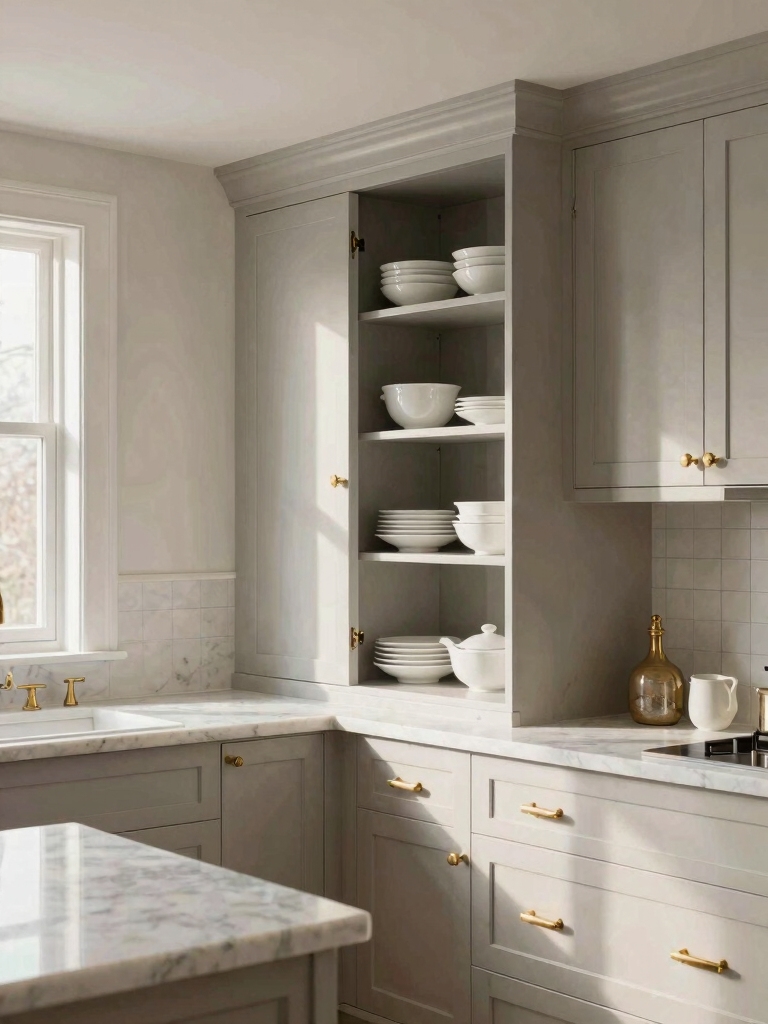
The first remodel win costs the least and does the most: paint the whole kitchen one light, low-contrast color. A single pale tone across the cabinets, walls, and trim removes the breaks where one color stops and another starts, so the eye takes the kitchen as one continuous space. A tiny kitchen looks instantly larger when nothing chops it up. One color, one room.
You do not need stark white, and you should not need much else once the color is unified:
- Keep the cabinets and walls within a shade or two of each other
- Match the ceiling near the wall color so the room feels taller
- Use soft white, greige, or pale sage to stay warm
- Save any bold color for one small, removable accent
Two myths that shrink a tiny-kitchen remodel:
❌ Myth: Small kitchens need small everything
✅ Reality: Often the opposite. Large-format tile, big slabs, and a single sweep of color read calmer and bigger than lots of little pieces and busy patterns.
❌ Myth: You must knock down a wall to feel space
✅ Reality: Rarely. Light color, a mirror, glass cabinets, and continuous surfaces fake more room than most wall removals, for a fraction of the cost and mess.
Mirrors to Double the Space

A mirror is the boldest tiny-kitchen remodel win, because it visually doubles whatever it reflects. A mirrored backsplash or even a framed mirror on an end wall bounces light and creates the illusion of a room beyond, so a closet of a kitchen suddenly feels open. In a windowless space, the reflection does the work a window would. Light from nowhere.
Keep it to one reflective surface so the kitchen does not turn into a hall of mirrors. A mirrored or high-gloss backsplash behind the counter is usually enough to lift the whole room. For more reflective tricks, my small kitchen remodel tricks that make a tiny space feel huge guide goes deeper.
Large-Format Tile to Expand the Room

It feels backward, but large-format tile makes a tiny kitchen look bigger, not smaller. Big tiles mean fewer grout lines, so the floor looks like one continuous sweep, not a busy grid of little squares that chops up the room. Keep the grout thin and close to the tile color, and the breaks all but disappear. Fewer lines, bigger floor.
The same idea works on the walls and backsplash: a few large slabs feel calmer than dozens of small tiles. Run the floor in the same direction across the whole kitchen, and the unbroken plane stretches the space. It is a remodel win that costs no more than busier tile would.
Glass-Front Cabinets to Open the Walls

Solid upper cabinets look like a wall of boxes, so swapping a few doors for glass fronts lightens the whole kitchen. The eye travels past the glass to the wall and dishes behind, which adds a layer of depth a solid door blocks. It is the look of a custom kitchen for the cost of a few cabinet doors.
Glass fronts also keep the practical storage you need while opening the room visually, so you do not trade function for the effect. Light the inside of a glass cabinet and it glows like a feature at night. A small touch, a big effect.
Use glass on one or two cabinets, not the whole run, so it stays special. For more on lightening the walls, my small kitchen ideas modern homes are loving piece covers the look.
Which flooring expands a tiny kitchen most?
1Large-format tile or plank
Big pieces with thin, color-matched grout read as one continuous sweep, which stretches the floor. The strongest space-expanding choice.
2Small mosaic or busy pattern
Lots of grout lines and a busy pattern chop the floor into pieces and make a tiny kitchen feel smaller. Save it for a tiny accent, not the floor.
Flexible Furniture That Folds Away

A remodel is the chance to build in flexible furniture that gives a tiny kitchen a table and prep space without permanently filling the floor. Fold-down counters, pull-out tables, and benches with hidden storage all appear when you need them and vanish when you do not, which keeps the kitchen open most of the time. The floor stays clear for living.
Plan these in while the walls are open, since some need backing or wiring behind them:
- A wall-mounted drop-leaf counter that folds flat between meals
- A pull-out table hidden inside a base cabinet
- A bench with a hinged seat that hides bulky pots
- A fold-out prep ledge beside the stove for extra surface
A Portable Island for Prep

A tiny kitchen can have an island; it just needs to move. A portable island on locking wheels rolls in for prep and out of the way after, so you get the surface and storage of a built-in without committing the floor. Size it to your clearances and it adds a whole work zone you can park against the wall:
- Locking casters so it holds steady while you chop, then rolls free
- A butcher-block top big enough to actually prep on
- Storage below for the cabinet you wish you had
- A footprint that leaves at least 36 inches of walkway around it
A Fold-Down Dining Nook

A remodel can carve out a real place to eat even in the tightest kitchen with a fold-down dining nook. A wall-mounted table that drops flat, paired with stools that tuck away, gives you a two-seat spot that takes a few inches of wall when it is closed. It is the win that makes a tiny kitchen feel like a real home:
- A wall-mounted drop-leaf table at counter or table height
- Two backless stools that slide fully under or hang on hooks
- A small pendant above to mark the nook as its own spot
- A spot near a window if you have one, for light while you eat
| Free floor | Island size | Best use |
|---|---|---|
| Under 36 inches | Skip it, use a cart | Roll-in prep only |
| 36 to 48 inches | 18 by 30-inch cart | Prep and storage |
| 48 inches plus | 24 by 36-inch island | Prep, storage, a seat |
Maximize the Vertical Storage

A remodel is the moment to claim the wasted air above standard cabinets, and vertical storage is the win that adds capacity without a bigger footprint. Taking the cabinets to the ceiling and stacking storage upward holds far more in the same floor plan, and it draws the eye up, which makes a low kitchen feel taller. Plan it in while you are at it:
- Cabinets carried all the way to the ceiling, no soffit gap
- Glass fronts up high to keep the tall wall from feeling heavy
- A tall, narrow pantry column in any slim gap
- A backsplash rail for the daily tools to clear the counter
Maximize Every Corner

The corners are where a tiny-kitchen remodel quietly wins or loses, since a blind corner can swallow a couple of cubic feet of storage. Building a corner solution into the new cabinets, a rotating carousel or a magic-corner pull-out, brings that dead wedge back into use. In a small kitchen, recovering the corner is recovering real capacity. Corners are gold.
Win the Blind Corner
Spec the corner mechanism during the build, since retrofitting one later costs more. A carousel spins the back into reach; a magic corner glides the inner shelves out as the door opens.
Solve the corner and the new kitchen out-stores the old one in the same footprint. For where to put it all, my small kitchen storage ideas to hide clutter guide helps.
Styling Tips to Finish the Remodel
Once the build is done, styling is what carries the illusion the rest of the way. Keep the new counters nearly bare, two or three intentional things at most, so the surfaces stay calm and the eye keeps traveling. A cluttered counter undoes every space-expanding choice you just paid for, no matter how big the tiles or how bright the paint.
Then add one warm note, a plant, a wood board, a brass rail, and stop. In a tiny kitchen, restraint is what keeps a remodel looking designed, never cluttered. Keep the palette light, the surfaces clear, and the sightlines open, and a small kitchen will feel every bit as grand as the square footage suggests it should not. For more low-cost polish, my small kitchen ideas on a budget under 500 dollars guide helps stretch it.
Tiny Kitchen Remodel Questions, Answered
?Do large tiles make a small kitchen look bigger?
Yes. Large-format tiles have fewer grout lines, so the floor reads as one continuous sweep instead of a busy grid of small squares. Keep the grout thin and close to the tile color, run it in one direction across the whole kitchen, and a small floor looks noticeably more expansive.
?What is the best paint approach for a tiny kitchen remodel?
Paint the whole kitchen one light, low-contrast color, cabinets, walls, and trim within a shade or two of each other. Removing the breaks where colors change makes the eye read the room as one continuous space. Soft white, greige, or pale sage all open a room while staying warm.
?Are glass-front cabinets a good idea in a small kitchen?
They are, used in moderation. Glass fronts let the eye travel past the door to the wall behind, which adds depth and lightens a wall of solid boxes. Use them on one or two cabinets rather than the whole run, keep what is inside tidy, and light the interior for a feature glow.
?How do I add a place to eat in a tiny kitchen remodel?
Build in a fold-down dining nook: a wall-mounted drop-leaf table that drops flat when closed, with two backless stools that tuck under or hang on hooks. It takes only a few inches of wall when not in use and gives a tiny kitchen a real two-seat spot to eat without a permanent table.
?What is the highest-impact tiny kitchen remodel win on a budget?
Light paint plus a mirror. Together they run under a hundred dollars and do more to enlarge a tiny kitchen than most built-in changes. Add a glossy or mirrored backsplash and unify the surfaces, and you get most of the space-expanding effect of a full remodel for very little money.
Size Was Never the Point
A tiny kitchen remodel that feels grand is not the one with the most square footage; it is the one that made the smartest choices. Light one color across it, run the surfaces unbroken, bounce the light with a mirror, lighten the walls with glass, and claim the corners and the vertical air. Each win costs no more floor than a worse choice would.
So as you plan your own remodel, judge every choice by one question: does it add light, run a line unbroken, or open a sightline? Which single win would change your kitchen the most? Start your plan there, stack the rest behind it, and your finished tiny kitchen will prove, every day, that size means nothing next to good design.
More Ideas Here


