

Why does the sink, the spot we use most, end up the most boring corner in the kitchen? It does not have to be. With the right basin, a sculptural faucet, and a backdrop that pulls the eye, the sink zone can go from purely functional to the moment that makes a kitchen feel designed.
These are the ideas that turn a plain sink corner into a genuine focal point, working outward from the basin to the faucet, the backdrop, and the lighting that frames it all. I have priced each and named its downside, since a sink that demands attention also has to survive daily dishwashing. Treat the whole zone as one composition and even a small kitchen gains a centerpiece.
Making the Sink the Star
- Pick one hero element, a colored basin, a bridge faucet, or a slab backsplash, and let the rest of the zone support it.
- Frame the sink: a striking backdrop, accent lighting, and styled open shelves turn the basin into a composed corner instead of a plain fixture.
- Balance drama with use, since a focal-point sink still scrubs pots daily, so choose materials and finishes that survive real life.
Start With a Functional Kitchen Sink Selection

Before chasing drama, remember that the sink you are dressing up gets used dozens of times a day, so the focal point has to start with a basin that works. A deep single bowl that fits a sheet pan, a quiet sound-deadened build, and a material that survives your cooking are the foundation everything decorative sits on. Beauty that fails at the dishes is not worth it.
Function first, drama second
Get the working basics right first, then the statement choices land on something solid. A bold colored sink that scratches in a month, or a shallow basin that splashes the floor, undermines the whole effect. Our modern sink design guide weighs the practical basin choices in depth.
Once the basin earns its keep, you have permission to make it bold. The order matters: function first, focal point second, so the corner you made beautiful also stays a pleasure to use.
Choose Statement Kitchen Sink Materials
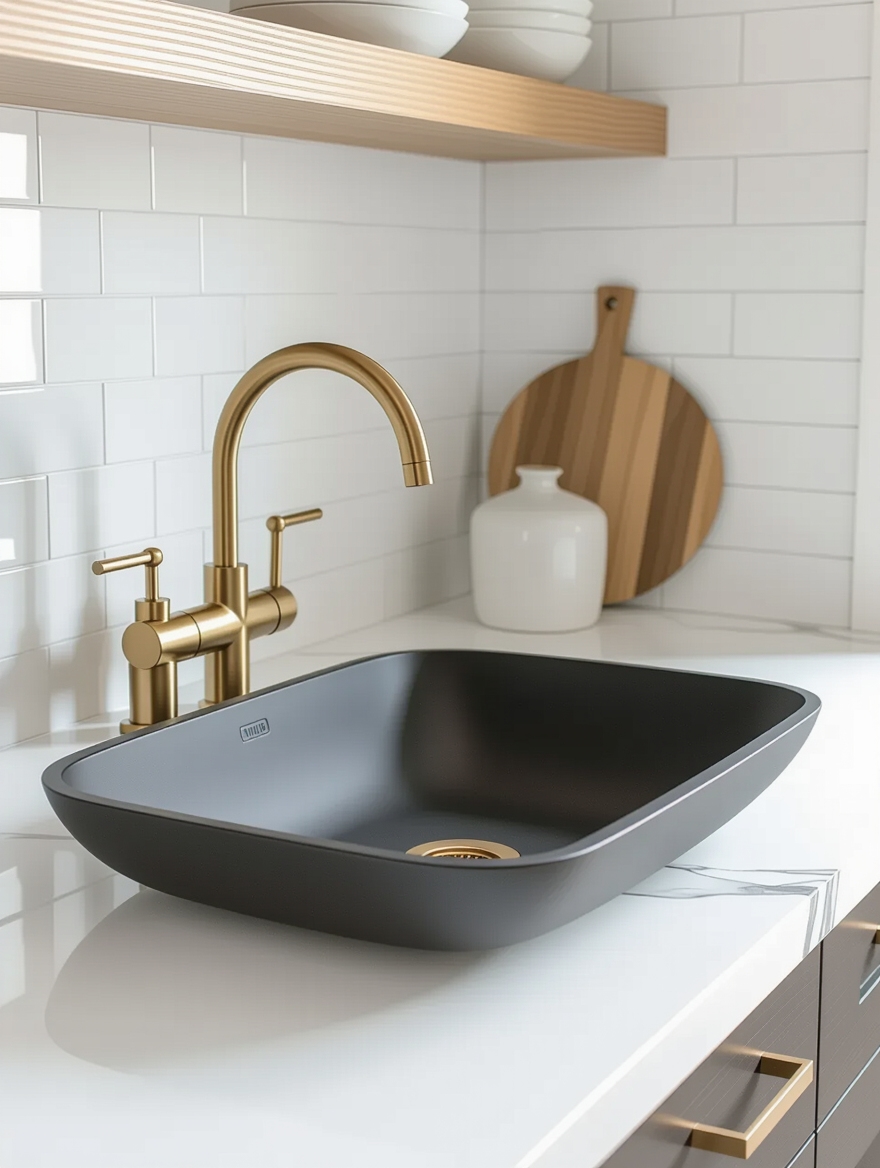
The fastest way to make the sink a focal point is a basin that demands a second look. I reach for a hammered-copper or colored fireclay basin when a kitchen needs one clear star. Hammered copper, fireclay in a bold color, fluted apron fronts, and matte black composite all turn the basin itself into the star, no extra decor required. The right material does the heavy lifting on its own.
- Choose hammered copper or a colored fireclay apron for a basin that is the centerpiece
- Pick a fluted or reeded apron front for texture on the one part everyone sees
- Match the material to your upkeep, since copper patinas and fireclay shows hard knocks; see our never-knew sink options
A few terms that come up when you make the sink a feature:
📖Bridge faucet
A faucet where the hot and cold lines join in a visible horizontal bar above the deck. Reads classic and sculptural, a natural statement piece over a focal-point sink.
📖Apron front
The exposed, forward-facing panel of a farmhouse sink. It is the part most on show, which is why a fluted or colored apron makes such a strong focal point.
📖Slab backsplash
A single sheet of stone or quartz behind the sink instead of tile. Smooth, high-end, and easy to wipe, it frames the basin like art.
Bold Colors in the Kitchen Sink Zone

A sink in a saturated color, deep blue, forest green, matte black, even a soft pastel, is one of the boldest focal points you can make, since color draws the eye faster than anything. Composite and fireclay both come in real color, so the basin becomes a deliberate design moment, not a neutral afterthought. In an otherwise calm kitchen, a colored sink sings.
The trick is letting the color be the star and keeping its surroundings quiet, so the basin pops. Pull the sink color from an accent elsewhere, a tile, a stool, a pendant, and it looks intentional, not random.
- Choose a saturated basin color and keep the counter and cabinets around it calm
- Echo the sink color once elsewhere so it looks planned, not accidental
- Lean to darker tones if you worry about stains, since they hide hard-water film better
A Stylish, Functional Statement Faucet

The faucet rises above the basin like a small sculpture, which makes it the easiest single piece to turn into a statement. A tall bridge or gooseneck faucet, an articulated pot-filler style, or a bold finish like matte black or aged brass draws the eye up and anchors the whole sink zone.
A statement faucet runs roughly $150 to $400, more for designer pieces, and swaps onto an existing line in about an hour, and it pairs naturally with the upgrades in our sink upgrade guide.
- Choose a tall bridge or gooseneck shape for sculptural height over the basin
- Pick a bold finish, matte black or unlacquered brass, to make the faucet the accent
- Confirm the faucet clears your window or upper cabinet before you buy a tall one
Two focal-point myths worth correcting:
❌ Myth: A statement sink has to be expensive.
✅ Reality: Not necessarily. A bold paint-grade backdrop, a $150 statement faucet, or a colored composite basin can carry the whole focal point without a luxury budget. The drama comes from a clear hero, not a big spend.
❌ Myth: A focal-point sink sacrifices function.
✅ Reality: Only if you choose looks over use. The best statement sinks start with a deep, practical basin and durable materials, then add the drama on top, so the corner is beautiful and works hard.
Mixing Metals to Enhance Style

A focal-point sink zone gains depth when the metals are mixed with intention. A brass faucet against black hardware, or a stainless basin with an aged-bronze drain and soap pump, gives the corner a layered feel. I love a brass-and-black pairing here, since the warmth and the contrast read custom. The mix is what makes the zone look designed and intentional.
One metal leads, the others support
The logic that keeps it from looking accidental is simple: let one metal lead and the others support, and keep warm metals with warm undertones. Two or three finishes are plenty, each repeating somewhere so the eye reads a pattern.
Tie the sink metals to the rest of the kitchen so the focal point connects to the room. A brass faucet that echoes the cabinet pulls or the lighting pulls the whole space together around the sink, which is exactly what a focal point should do.
A Unique Backsplash Behind the Sink
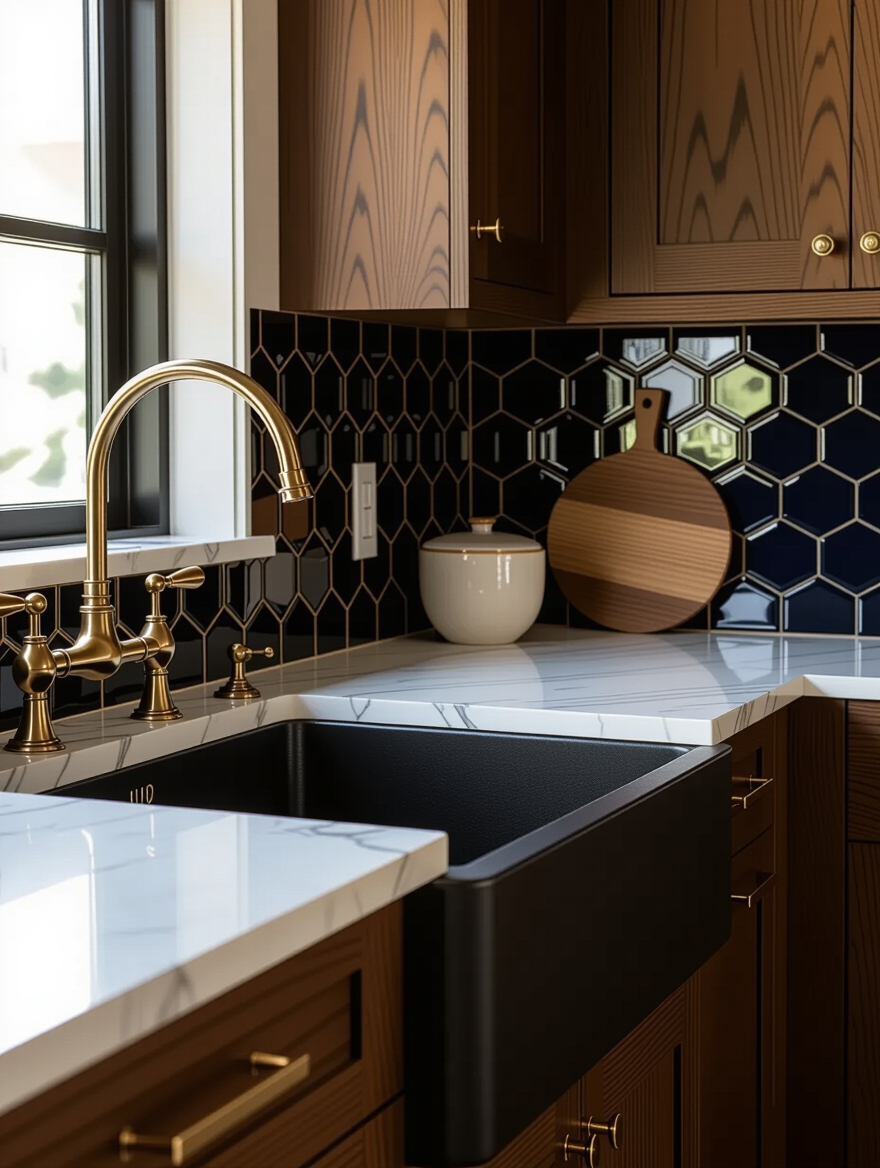
The wall directly behind the sink is the backdrop to your focal point, so an unconventional material there makes the whole zone sing. A full-height stone slab, a mirrored panel that bounces light, or a band of hand-glazed tile turns the backdrop into part of the statement. Because the area is compact, you can be bold for a modest spend.
A slab backsplash that matches or contrasts the counter looks especially high-end, framing the basin like art on a wall. Taking the material all the way up behind the sink, rather than stopping at the standard four inches, is what gives it real presence.
Whatever you choose, keep it wipeable and well-sealed, since this is the wall that catches every splash. Get that right and the backdrop lifts the whole corner, the trick our backsplash ideas explore in full.
👍Make the sink a focal point when
- +The sink sits on a visible run or island where guests actually see it
- +Your kitchen is otherwise calm and can carry one bold statement
- +You will choose durable materials that survive daily dishwashing
👎Keep it simple when
- –The sink is tucked in a corner no one sees, where the spend is wasted
- –The kitchen is already busy, so another bold element tips into chaos
- –You would pick a fragile finish that cannot take real cooking
Stylish Patterned Tile

Where a slab feels too sleek, patterned tile brings personality, and the sink wall is the perfect low-risk place to try it. Encaustic cement tile, a bold geometric, or a hand-painted Mediterranean pattern turns the splash zone into a small piece of art. The compact area means even a pricey tile stays affordable here.
Let the tile be the only loud thing
The key is letting the pattern be the only loud thing in the zone, so the cabinets, counter, and basin stay quiet around it. A busy tile against busy everything else just reads chaotic, while a bold tile framed by calm surfaces becomes the focal point.
Seal the grout well, since patterned tile behind a sink takes constant water and grime. A wipeable glaze and sealed grout lines keep the art looking sharp instead of dingy within a season.
Functional, Stylish Under-Cabinet Lighting

A focal point you cannot see at night is only half a focal point, which is why lighting frames the sink zone as much as any material. Under-cabinet strips or a small pendant over the sink wash light across the basin and backdrop, making the materials glow and the corner feel intentional after dark. Lighting is the cheapest way to give the zone presence.
If there is no upper cabinet, a single pendant or a pair over the sink does the same framing job and adds a decorative layer of its own. Put the light on a dimmer so the sink corner can glow softly in the evening, the finishing touch most people forget.
- Add under-cabinet LED strips, around $30 to $80 a kit, to light the basin and backdrop
- Hang a pendant over a sink with no upper cabinet for framing plus decoration
- Use a warm 2700 to 3000 kelvin bulb on a dimmer so the corner glows at night
Stylish Open Shelving Around the Sink

A short run of open shelving beside or above the sink frames the basin and gives the focal point context, a place for a plant, a stack of bowls, or a few characterful pieces. The styling around the sink turns a single fixture into a composed corner, the way art and objects frame a fireplace. Keep it light so it supports the sink rather than stealing from it.
Style it to support the sink, not steal from it
Style the shelves with the sink in mind, echoing its metal or color in a small piece or two so the whole zone reads as one composition. I tell clients a single trailing plant softens the hard edges of the basin and faucet better than any gadget.
Be honest that shelves right by the sink catch splashes and grease, so display wipeable pieces and the things you actually use there. Our open-shelf styling formulas cover how to keep it curated rather than cluttered.
Pull the Kitchen Aesthetic Together

The strongest sink focal points are a whole corner, not one lonely object, where the basin, faucet, backdrop, lighting, and shelving all speak the same language. When the brass of the faucet echoes the shelf brackets, and the tile picks up the basin color, the zone comes across as a single, intentional composition rather than a pile of nice things. That coherence is what separates a focal point from a clutter of upgrades.
So plan the zone as a whole before you buy any one piece, choosing a hero element and letting the rest support it. Step back and check that nothing fights for attention; the corner should draw the eye to one clear star with everything else in harmony around it. Done that way, even a humble sink becomes the part of the kitchen people notice first.
Common Mistakes to Avoid
A few predictable errors turn a would-be focal point into a busy mess. The biggest is making everything loud at once, a colored basin and a bold faucet and patterned tile and mixed metals all fighting, so nothing wins. Pick one hero and keep the rest calm. The second is chasing looks over use, since a basin that scratches or a faucet that hits the window is a daily irritation no beauty redeems.
Other traps include forgetting the lighting, so the feature vanishes after dark, and over-styling the shelves until the sink itself disappears behind clutter. Plan the zone as one composition, confirm any plumbing or electrical work with a licensed pro, and keep function alongside the drama. Get that balance right and the spot you stand at most becomes the corner guests admire first.
Focal-Point Sink Questions People Ask
?How do I make my kitchen sink a focal point on a budget?
Pick one affordable hero and keep the rest calm. A bold backdrop of patterned tile or paint, a $150 statement faucet in matte black or brass, or a colored composite basin each carries the focal point without a luxury spend. The drama comes from a single clear star, not from spending on everything at once.
?What makes a sink look high-end?
Coherence and a clear focal element. A statement basin or faucet, a full-height slab or tile backdrop, mixed metals with a logic, and warm accent lighting that all speak the same language read far more expensive than a pile of unrelated upgrades. Framing the basin with light and a styled shelf or two completes the effect.
?Can a focal-point sink still be practical?
Yes, if you build it on a working basin first. Start with a deep, durable, sound-deadened sink that fits your cookware, then add the color, faucet, and backdrop on top. The best statement sinks survive daily dishwashing because function was the foundation, not an afterthought.
Build the Corner Around One Clear Star
Turning the sink into a focal point is less about spending big and more about composing the whole corner around one hero, a colored basin, a sculptural faucet, or a striking backdrop, with everything else in quiet support. Start from a basin that works, add a single bold element, and frame it with backdrop and light.
So look at your own sink corner and decide which one element you want to be the star, then keep the rest calm enough to let it shine. Done with that restraint, the spot you stand at most stops being the dullest corner in the kitchen and becomes the one people notice first.
More to Explore


