
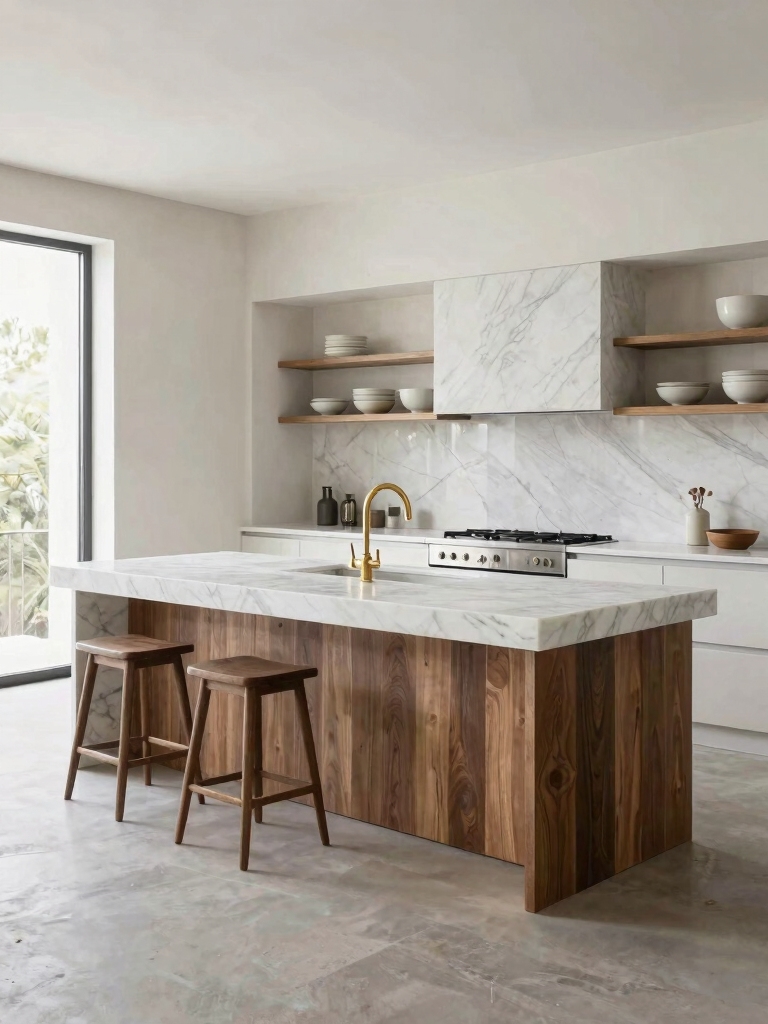
Most people rule out an island because they picture a four-foot block and 42 inches of aisle on every side. That is the showroom version. The truth is a useful island can be 24 inches wide, hang off a wall, or roll away entirely, and the only number that really decides it is your walkway.
So these nineteen small kitchen island solutions are sorted by the inches they actually need. Every one comes with real dimensions, clearances, and a rough price, so you can hold a tape measure to your floor and know in a minute whether it fits.
The Numbers That Decide It
- A small island earns its place at just 24 to 30 inches wide
- Leave 36 inches of walkway on every open side, 42 if two people cook
- Slim the depth to 12 to 18 inches and it slides into a galley
- For a seat, plan a 10-inch overhang and 24 inches of width per stool
- When the floor is too tight, go wall-mounted, fold-down, or movable
A Movable Cart Needs Just Two Feet

The most space-thrifty island is a movable cart, and the good news is how little it asks for. A cart 18 to 24 inches deep and 30 inches wide gives you a real prep surface and a shelf of storage, then rolls clear when you need the floor. That is a two-foot footprint doing the work of a built-in.
Buy one with locking wheels and a top you can actually chop on, around $80 to $200. The cheap wire ones wobble. I have returned two of those. A solid butcher-block cart holds steady and lasts.
Because it moves, it never permanently steals an inch. Park it under a window, against a counter, or out in the hall between meals. For more budget-minded picks like this, see my small kitchen ideas on a budget under 500 dollars guide.
A Table as a Stand-In Island

A plain table is the island hiding in plain sight. A console or craft table 16 to 20 inches deep slips into a narrow kitchen and gives you a fixed prep surface for the price of secondhand furniture. Height is the catch. A standing table is usually a few inches lower than your counter, so check the gap before you commit and plan to raise it if needed.
If the height is off, riser legs or taller feet close the gap. Top it with a butcher block and it becomes a true work surface. A table island costs whatever you pay for the table, often under $60.
A Rolling Island Between Two Zones

A rolling island bigger than a cart, with drawers and a thick top, parks between your cooking and cleanup zones and locks down where you stand most. It bridges the gap in a galley without permanently filling it. When the room needs to breathe, you roll it aside.
Aim for one around 20 by 36 inches with four locking casters, $150 to $300:
- Lock it mid-floor for prep, then roll it aside to clear the room
- Keep deep drawers for the pots a wall cabinet cannot hold
- Check that a locked top sits flush with your counter height
- Confirm it fits through your doorway before you buy
A Rolling Trash-and-Storage Center

One of the smartest uses of island inches is a rolling trash center: a cart that hides the garbage and recycling bins inside, topped with a prep surface. It pulls double duty, reclaiming the floor your standing bins used to block and adding counter on top. Bins eat real floor space. In a small kitchen that swap alone is worth it.
Look for a unit with two pull-out bins and a butcher top, around $90 to $180:
- Two slide-out bins so trash and recycling stay separated
- A sealed or lined cavity to keep odors down
- A wipeable top you can prep on above the bins
- Casters so it rolls to the back door on collection day
Two sizing myths keep people from ever trying an island:
❌ Myth: You need four feet of clearance
✅ Reality: Thirty-six inches is the working minimum on an open side. Four feet is comfortable, not required, and movable islands need even less.
❌ Myth: A small island is not worth the bother
✅ Reality: A 24-inch cart adds real prep space and storage. Whether an island works comes down to clearance, not how grand it looks.
A Wall-Mounted Drop-Leaf in Six Inches

When the floor has nothing to give, a wall-mounted drop-leaf is the answer that costs almost no inches. Folded, it is a six-inch strip on the wall. Lifted on its bracket, it becomes a 16 to 20-inch counter for prep or a quick meal, then drops flat again. This is as space-thrifty as an island gets:
- Mount it into studs with a gate-leg or folding bracket rated for weight
- Set the open height at 36 inches to match your counter
- Choose a depth of 16 to 20 inches, enough to roll out dough
- Expect $40 to $120 for a sturdy hinged shelf and bracket
A Fold-Up Shelf Over a Base Cabinet

A fold-up shelf hinged off the side or top of a base cabinet turns existing furniture into a flip-up island. It borrows the cabinet you already have, so it adds counter without adding a footprint. Lift it for prep, fold it down when you are done, and the kitchen looks the same as before.
Keep It Flush
Use a heavy-duty drop-leaf hinge and a support arm, and keep the leaf no deeper than the cabinet is tall so it folds flush. A loaded leaf pulls hard, so the bracket rating matters more than the look.
I added one of these to the end of a galley run once and it gave a renter a real prep surface for under $50. It is the cheapest island on the list.
“What to ask before a carpenter cuts anything: the exact finished height against your counter, the bracket weight rating, and whether the wall has studs where you want the shelf. A fold-up or wall-mounted island lives or dies on those three numbers.”
A Narrow Shelf Unit for a Galley

In a galley, a narrow shelf unit 10 to 14 inches deep stands against the open end and gives you storage plus a small landing surface on top. It is barely deeper than a bookshelf, so it never chokes the aisle, yet it holds cookbooks, jars, and the small appliances that crowd the counter.
Top it with a cut-to-size butcher block and you gain a prep spot too. Anchor a tall unit to the wall so it cannot tip. For the storage logic behind it, my small kitchen storage ideas to hide clutter guide goes deeper.
A Corner Floating Shelf Island

The forgotten inches in most small kitchens sit in a corner, and a corner floating shelf claims them as island space. Mounted across a corner at counter height, it gives you a triangular prep ledge that uses room nothing else wants. No legs, no floor footprint, just bracket and board.
Keep it to 12 to 16 inches off each wall so it does not jut into the path:
- Bracket it into studs on both walls for a solid corner anchor
- Hold the reach to 12 to 16 inches so elbows clear it
- Use the wall above for hooks or a small shelf stack
- Round the front corner so no one catches a hip on it
A Tiny Peninsula for Two Seats

A tiny peninsula attaches to one counter run and reaches out just far enough to seat two, which makes it fit where a freestanding island cannot. At 12 to 18 inches deep with a 10-inch overhang, it gives you prep on the kitchen side and a perch on the open side. One end stays anchored, so it never needs clearance on all four sides.
Seat Two Without the Sprawl
Plan 24 inches of width per stool and backless seats that tuck fully under. That keeps the walkway clear when no one is eating.
A peninsula is the move when you want seating but the floor cannot spare a full island. I put peninsulas in more small kitchens than full islands, for exactly that reason. For the design-forward version, see my small kitchen ideas modern homes are loving piece.
Which tiny island size fits your kitchen?
1Under 24 inches of free floor
Go wall-mounted or fold-down. A standing island will block the room, so let the wall carry it.
224 to 40 inches of free floor
A slim cart or a 12-inch peninsula fits. Keep it movable if two of you cook at once.
A Freestanding Island Sized to Fit

If you do want a real freestanding island, the trick is sizing it to the room instead of a catalog. A 24 by 36-inch island is plenty for prep, storage, and a single seat, and it leaves the aisles a tight kitchen needs. Scale to the room. Bigger looks impressive in a photo and blocks the floor in real life.
Measure your clearances first and let them cap the size. You want 36 inches around it, more near the oven or dishwasher swing. Whatever is left over is your maximum island, not your goal.
Done right, even a stock-cabinet island built for $200 to $500 outperforms an oversized one. For the unconventional formats most lists skip, my small kitchen island ideas nobody talks about guide covers them.
More Inch-Saving Island Builds
A few more formats squeeze function out of almost nothing. Each one fits a specific tight spot:
- A pull-out table that slides from a base cabinet and hides flush, around $120 to $250
- A two-tier island that screens the prep mess behind a raised bar for seating
- A slim open-shelf cabinet, 12 inches deep, that rolls in as a movable island
- A mixed open-and-closed base so daily items stay reachable and clutter hides
- A butcher-block top on any of the above to turn a shelf into a true prep zone
Turn a Bookcase Into an Appliance Island
The most resourceful inch-saver is a repurposed bookcase or low cabinet turned into an island that hides a small appliance. Stand a short, sturdy bookcase upright, top it with a cut butcher block, and tuck a microwave or mini fridge into one of the openings. A bulky appliance leaves your counter and the island gains a job.
Secure it so it cannot shift and leave the appliance side ventilated and reachable. Keep any wiring simple and call a pro for anything beyond a plug-in. It is the cleverest way to recover counter inches and a cabinet at the same time, for the cost of furniture you may already own.
Small Island Sizing Questions, Answered
?How small can a kitchen island be?
About 24 inches wide by 18 to 24 inches deep is the smallest that still earns its place, enough for prep and a shelf of storage. Below that you are better off with a cart or a wall-mounted shelf. The floor around it matters more than the island itself.
?How much clearance do you need around a small island?
Leave at least 36 inches of walkway on every open side. Bump that to 42 inches if two people cook or if the island sits near an oven or dishwasher that opens toward it. Less than 36 inches and the room jams every time a door swings open.
?Is a 20-inch-wide island too small?
For a standing island, 20 inches is tight but workable as a slim prep ledge or a narrow peninsula. You will not fit deep drawers, so use it for surface and light storage. If you need real capacity, look at a deeper cart instead of forcing a too-narrow build.
?How much does a small kitchen island cost?
A secondhand table runs under $60, a solid rolling cart $80 to $200, and a stock-cabinet build $200 to $500. Wall-mounted and fold-down shelves land in the $40 to $120 range. Custom millwork costs far more, but a small kitchen rarely needs it.
?What is the smallest island that can have seating?
A peninsula or island about 18 inches deep with a 10-inch overhang seats one or two on backless stools. Plan 24 inches of width per seat. Anything shallower and there is no knee room, so the stools end up blocking the aisle instead of tucking under.
Measure First, Then Choose
The island that maximizes every inch is never the biggest one you can cram in. It is the one matched to your clearances, doing the single job your kitchen most needs, and sized so the room still moves around it.
So pull a tape measure before you shop. Measure twice, buy once. Mark your walkways, find the tightest one, and let that number pick the format. Whether it ends up a 24-inch cart or a fold-down shelf, the right small island gives back every inch it borrows.


