

A client once showed me a freshly finished mid-century remodel that had every big piece right, walnut cabinets, a Sputnik light, a tulip table, and it still felt off. The problem was all in the small stuff: chunky bullnose counters, modern shaker doors, and shiny surface hinges that no 1958 kitchen ever wore.
The signature pieces get all the attention, but the details below are what separate a kitchen that nods at the era from one that actually convinces. These are the nineteen small decisions most midcentury remodels overlook, with honest costs and what to ask your contractor before the work starts.
The Small Details That Decide It
| Detail | Why It Gets Missed | Quick Win |
|---|---|---|
| Door style | People default to shaker | Choose flat-panel slab doors instead |
| Hinges | Hidden inside the cabinet | Use concealed hinges, not surface-mount |
| Counter edge | Nobody thinks about the profile | Pick a square or eased edge, never bullnose |
| Flooring pattern | Treated as an afterthought | Try period laminate, vinyl, or a checkerboard |
The Details That Make It Read Mid Century

Before the fun shopping starts, it helps to know what the eye is actually reading when a kitchen feels right. It is rarely one hero piece. It is the accumulation of small, correct choices: the door profile, the edge of the counter, the way the hardware sits, the flooring underfoot.
Where the Look Really Lives
Most remodels nail the obvious and miss these, which is why so many mid-century kitchens look almost right but not quite. The good news is simple. The small fixes are usually the cheap ones.
Get the signature pieces from the broader enduring elements, then spend your attention here, on the details that do the quiet convincing.
Architectural Details: Pass-Throughs and Nooks

The era loved a kitchen that connected to the rest of the house, so the architectural bones matter as much as the finishes. A pass-through window to the dining room, a built-in nook, or a half-wall is more period-true than walling the kitchen off, and it brings in the light and openness the style was after.
- Open a pass-through to an adjoining room for that connected, postwar feel.
- Carve a shallow niche for display or a wall phone nook as a wink to the era.
- Keep sightlines low and open rather than blocking them with tall uppers everywhere.
📋Architectural Details to Plan First
- ✓A pass-through or half-wall to connect the kitchen to the next room.
- ✓A built-in nook or banquette that uses an awkward corner.
- ✓Low, open sightlines instead of tall uppers blocking the view.
An Asymmetrical Cabinet Layout

Here is a detail almost nobody plans: mid-century cabinetry was often deliberately asymmetrical, not the balanced, mirror-image layout we default to now. An off-center run, a break in the uppers, or a single tall pantry against lighter lowers feels more of the period than a perfectly symmetrical wall.
It also happens to suit how people actually use a kitchen, with storage weighted toward where the work happens.
- Break up a long upper run with open space or a window rather than filling every inch.
- Mix cabinet heights on purpose instead of one continuous line.
- Weight storage toward the cooking zone and let the rest breathe.
A Minimalist, Flat-Panel Door

If there is one detail that quietly ruins a mid-century remodel, it is reaching for shaker doors out of habit. Shaker is lovely and everywhere, but its framed-and-recessed panel belongs to a different tradition entirely. The era ran on flat slab doors with no frame at all.
Skip the Shaker Reflex
It is the first switch I tell clients to make, because flat-panel doors are the highest-impact correction available, and on sound boxes you can often do it through refacing rather than a full replacement.
If you are unsure whether your kitchen feels modern enough already, the calm minimalist base is a useful reference for how little ornament the look really wants.
🅰️Flat-Panel Slab
The period-correct choice: a frameless, flat door that lets wood grain or a clean color carry the look.
🅱️Shaker
Lovely but wrong era; its framed recessed panel belongs to a different tradition and quietly undoes the mid-century feel.
Mid-Century Pulls and Concealed Hinges

Hardware is where the details either hold up or fall apart at close range. The pulls should be slim tabs, recessed grips, or simple bars, but the part nobody mentions is the hinge: visible surface-mount hinges instantly look wrong, while concealed European hinges keep the doors clean and let the slab fronts speak. I recommend concealed hinges on every job; it is a small spend that changes everything up close.
- Choose concealed hinges so nothing interrupts the flat door face.
- Slim tab pulls or recessed finger grips run about $5 to $20 each and swap in minutes.
- Match every metal finish, the pulls, faucet, and lighting, to one tone for cohesion.
Balancing Open Shelves and Closed Cabinets
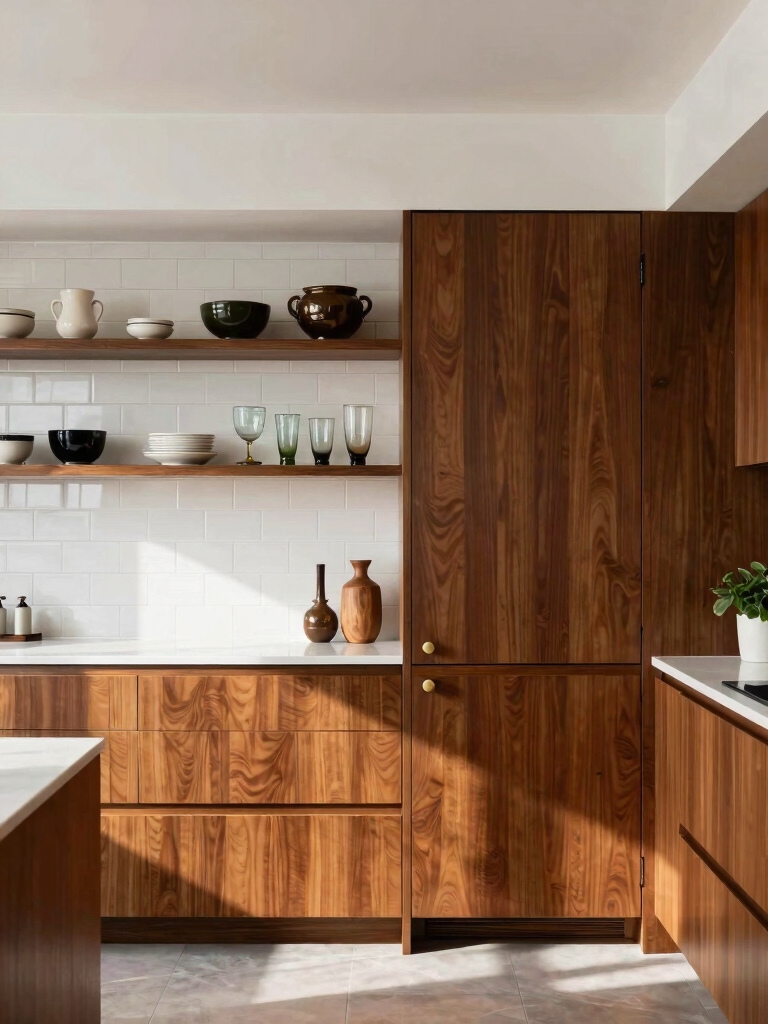
The ratio of open to closed storage is a detail people get wrong in both directions. All-closed feels heavy and dated. All-open turns into clutter the clean style cannot survive. The sweet spot is mostly closed cabinets with one deliberate run of open shelving, where a few good pieces sit on display and everything else stays tucked away.
- Aim for roughly one open zone to every several closed cabinets, not a wall of shelves.
- Put open shelving where you will actually keep it tidy, near the coffee or the sink.
- Use a single solid wood shelf rather than thin floating ones for a sturdier period look.
“What to ask your contractor about storage: What ratio of open to closed are we planning, and where exactly does the open shelving go? Can we keep most storage closed and use just one curated open run? Settling this before the cabinets are ordered prevents the cluttered, half-open look that ages a remodel fast.”
Personalize the Countertop Edge Profile

This is the one I see undo more good remodels than any other. A thick bullnose or an ornate ogee edge fights the clean lines the whole style depends on, no matter how right the rest is. The period look wants a simple square edge or a barely eased one.
The profile is everything here. Material matters far less. Laminate, quartz, or stone can all work, but the edge has to stay crisp and low.
If you want a true period nod, a laminate counter with a metal edge band is having a real comeback and costs far less than stone, usually $20 to $50 per square foot installed.
A Period-Correct Faucet and Sink
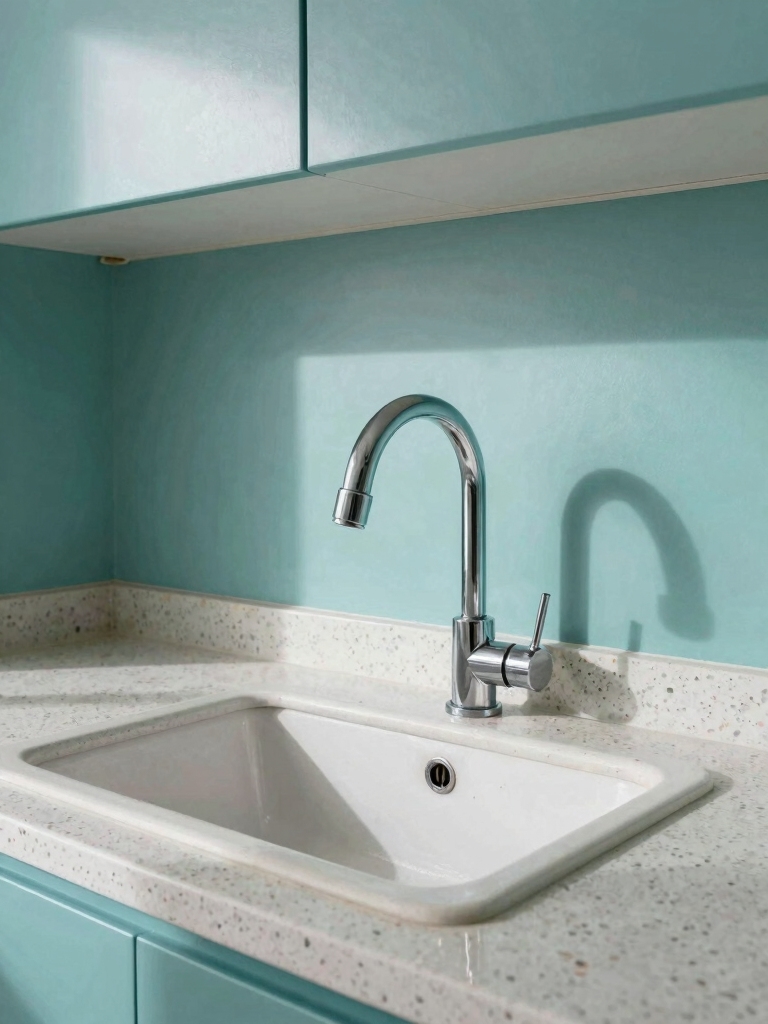
The faucet and sink are a quiet tell. A towering modern pull-down spout looks out of place against flat cabinets and a simple counter, while a low bridge faucet or a slim gooseneck in brushed metal sits right at home.
Keep the Spout Low and Simple
For the sink, a single deep basin or a classic drop-in with a thin rim suits the era better than a heavily styled farmhouse front.
You do not have to chase a true vintage fixture; a current faucet with the right simple shape gives you period looks and modern reliability together.
A Cohesive Geometric Backsplash
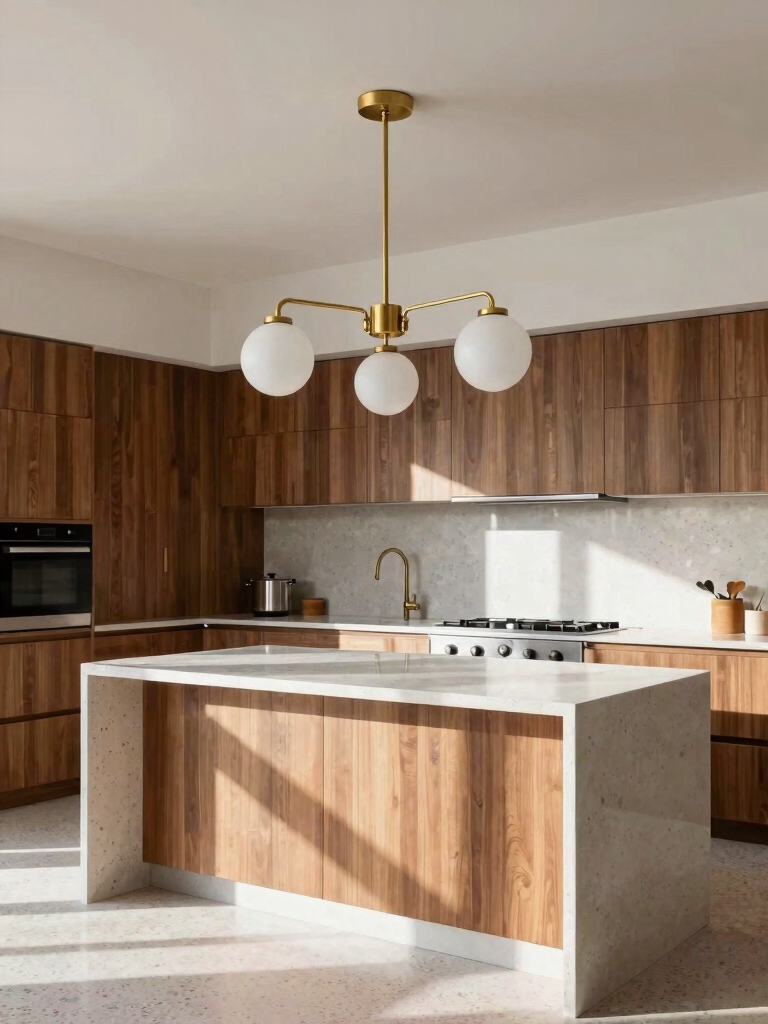
A backsplash can carry real personality here, but the overlooked part is cohesion: the tile has to talk to the counters, the cabinets, and the flooring rather than shouting on its own. A geometric tile in a color pulled from elsewhere in the room ties the whole kitchen together.
Make It Talk to the Room
Keep the palette tight, one or two colors, and let the shape do the work, whether that is an elongated hex, a stacked rectangle, or a small penny round.
Run the same tile a little further than feels necessary, up to a shelf or around a window, so it looks designed rather than dropped in. Plan it alongside the modern rustic texture you are layering in.
Vintage Flooring Patterns

Flooring is treated as an afterthought in most remodels, which is a shame, because the era had some of its boldest ideas underfoot. A checkerboard, a warm cork, or a patterned sheet floor grounds the whole look in a way a plain plank never will, and it is often cheaper than the wood everyone defaults to.
- A checkerboard vinyl or linoleum floor is the most recognizable period pattern.
- Cork is period-true, warm underfoot, and quiet, running about $3 to $8 per square foot.
- Coordinate the floor color with the cabinets and counters so it unifies rather than competes.
Vinyl and Linoleum, Done Right
Real linoleum and modern sheet vinyl deserve a second look for a mid-century remodel, and almost no one considers them. Genuine linoleum is a natural, durable material that was everywhere in period kitchens, and today’s luxury vinyl can copy a checkerboard or a marbled pattern convincingly for very little money.
Both are forgiving on a budget and easy underfoot, which is exactly why they fit a working family kitchen.
- Sheet vinyl runs about $3 to $7 per square foot and handles spills without complaint.
- True linoleum costs a bit more but is natural and lasts for decades.
- A two-tone checkerboard looks period at a glance and hides everyday wear.
Build a Built-In Breakfast Nook
The built-in breakfast nook is one of the most charming period details and one of the least planned. A banquette tucked into a corner, with a simple table and a pendant overhead, uses an awkward spot beautifully and seats more people than chairs would in the same footprint.
It is a real construction item, usually $1,500 to $4,000 for a built-in bench, but it adds storage under the seat and a daily gathering spot. For small kitchens especially, it earns its space many times over.
The Final Cohesion Checklist
Cohesion is the detail that ties the other eighteen together, and it is worth a deliberate pass before you sign off on anything. Stand back and check that the metals match, the wood tones agree, the edges stay clean, and one or two colors carry through the room rather than five competing ones.
If a single element feels louder than the rest, soften it. The most convincing mid-century kitchens feel calm and collected, and that calm comes from these small choices agreeing with each other. The timeless modern direction is a safe anchor if you ever feel a detail drifting too far into costume.
Styling Tips
Once the build is done, the styling is where a few last details pay off. Keep counters clear except for a couple of period-right pieces, a ceramic, a wood bowl, a single plant, and let the architecture be the star. Resist the urge to fill every surface.
Add warmth with one or two textiles and a single bold accent rather than a shelf of knickknacks. Restraint is the through-line of the whole style, and it is the cheapest detail of all.
Mid-Century Remodel Detail Questions
?What is the most common mistake in a mid-century kitchen remodel?
Reaching for shaker cabinet doors out of habit. The era is defined by flat slab doors, so shaker quietly undoes the look no matter how right the rest is. Concealed hinges and a clean counter edge are the next most-missed details.
?Are laminate counters really period-correct?
Yes, and they are making a real comeback. A laminate counter with a metal edge band is true to the era and costs far less than stone, usually $20 to $50 per square foot installed. The key is keeping the edge square and low.
?What flooring is best for a mid-century kitchen?
Patterned sheet vinyl, real linoleum, cork, or a checkerboard floor all fit the era and cost less than wood. Coordinate the floor color with your cabinets and counters so it unifies the room rather than competing with it.
?How do I make a new kitchen feel authentically mid-century?
Focus on the small details most remodels skip: flat-panel doors, concealed hinges, a square counter edge, simple low tapware, and a period floor. Match your metals, keep the palette tight, and let the architecture stay the star.
Sweat the Small Stuff
The hero pieces are easy; anyone can buy a Sputnik light. What actually convinces is the layer below it, the flat doors, the concealed hinges, the square counter edge, the period floor, all quietly agreeing with each other. Get those right and even a modest remodel reads true.
Pick a few of these overlooked details to focus on, ask your contractor the right questions early, and the small decisions will do the heavy lifting your budget cannot. That is where the soul of a mid-century kitchen actually lives.
More Looks We Love


