

Ever stood in a two-run kitchen and done the little side-step shuffle when the oven door and the dishwasher are open at the same time? That one detail tells you whether a parallel kitchen design was planned around how people actually move, or just drawn to fill a floor plan. Two facing counters can be the most efficient layout in the house when the gap, the storage, and the zones are right.
I have walked through dozens of these kitchens, and the good ones share a handful of choices anyone can copy. Below are layout moves that keep everything within a step or two, from the gap between runs to where the island and lighting go. Most cost far less than a remodel.
Quick Wins for a Parallel Kitchen
- Leave 42 to 48 inches between the two runs so two doors can open without clashing.
- Split jobs across the runs: cooking on one side, sink and prep on the other.
- Use the full height of both walls before adding any new footprint.
- Pick one busy material and one quiet one so the long sightlines stay calm.
- Layer lighting along both counters, since one ceiling fixture leaves shadows in a corridor space.
The Classic Parallel Layout, and Why It Holds Up

A parallel kitchen runs two straight counters facing each other, with a walkway down the middle. The reason it works is simple. You pivot in place. Sink behind you, stove in front, and most of what you reach for is a quarter-turn away rather than a walk across the room.
Where it earns its place
It also gives you twice the counter and twice the cabinet wall of a single-line kitchen in the same length. That makes it a strong pick for cooks who actually cook, since there is room to stage ingredients on one side while a pot works on the other. A close cousin is the galley kitchen, which uses the same two-wall logic in a narrower footprint.
The one rule that makes or breaks it is the gap between the runs. Too tight and doors bang; too wide and you lose the pivot that made it efficient in the first place.
Making a Small Parallel Kitchen Feel Light and Open

When the corridor is short, the goal is to stop the walls from closing in. None of these moves mean knocking anything down. I keep coming back to the same handful on tight floor plans, the kind you find in apartments and older small parallel kitchens where every inch counts and the budget rarely stretches to moving a wall. First-timers always ask me where to start, and it is here.
- Run light, low-contrast finishes on both walls so the eye doesn’t stop at a dark band halfway down.
- Take cabinets to the ceiling on at least one run, which draws the height up and hides clutter at the top.
- Swap one upper run for a slim glass-front cabinet so the wall feels less solid.
- Keep the floor one continuous color, since breaks make a narrow room feel chopped.
“Stand in the room and measure the gap between where both runs will sit. Under 42 inches, ask your designer whether one run can go shallower, say 21 inches instead of 24, to buy back walkway. It is a small change that decides how the whole kitchen feels.”
Storage That Cuts the Clutter on Both Runs

With two cabinet walls to play with, the trap is filling them with deep shelves you can never see into. Give every cabinet one job. Pull-out pantry units bring the back of the cabinet to you, which matters more in a parallel kitchen because you are often reaching across a narrow aisle with a hot pan in one hand. Clients ask me about these constantly, and they are worth the splurge.
Match the cabinet to the job
On the lower runs, I’d put deep drawers instead of doors wherever the budget allows. Drawers cost roughly $40 to $90 more per cabinet than a door-and-shelf box, and they pay it back every day by ending the crouch-and-dig. Tray dividers, a cutlery insert, and one drawer set aside for foil and wrap cover most daily friction.
For the gear you reach for hourly, under-cabinet hooks and a slim rail keep mugs and utensils off the counter. If clutter is the real problem, a few targeted storage tricks go further than another row of cabinets.
Adding an Island Between the Two Runs

An island only belongs in a parallel kitchen when the room is truly wide. The math is unforgiving. You need the center walkway plus the island plus clearance on the far side, and in a typical two-run kitchen that means a room pushing 12 feet across before an island stops choking the aisle. If you have the width, a center island turns the dead middle into prep space, casual seating, or a spot to park the groceries.
A prefab island runs about $400 to $1,500, while a built-in to match your cabinets usually starts around $2,000. For a smaller footprint, a rolling cart you can tuck away is a smart trial run before you commit. There are plenty of island ideas sized for tight rooms.
- Confirm at least 42 inches of walkway on every open side before measuring for the island top.
- Keep the island narrow, around 24 to 30 inches deep, so it doesn’t eat the aisle.
- Put seating on the end that faces away from the stove to keep splatter off whoever is sitting.
Heads-Up
Before you fall for an island, spend ten minutes taping its outline on the floor and opening every nearby door and drawer. If you can’t pass behind someone seated at it with 36 inches to spare, the room is telling you to skip the island and keep the aisle clear.
Getting the Work Triangle Right Across Two Lines

The work triangle still rules here. It just stretches across the aisle. The cleanest version puts the sink and fridge on one run and the stove on the other, so your busiest path is a single turn and the loop between water, heat, and cold storage stays short enough that you barely feel it during a weeknight dinner.
Where I see this go wrong is the fridge jammed at the far end, which forces you to walk the whole corridor mid-recipe. Keep the three points within a few steps of each other. Leave a clear stretch of counter beside both the stove and the sink for landing hot pans and dripping colanders.
If two people share the space, this is also what stops the bottleneck. One cook owns the stove run, the other works the sink and prep side, and nobody crosses the other’s path to get there.
Open Shelving Without the Visual Noise

Open shelves can lighten one wall of a parallel kitchen, but two full walls of them turn a tidy room into a busy one. My rule is to open up a single short run and leave the rest behind doors.
- Hang shelves on the run you face while standing at the sink, so the view is intentional.
- Store daily dishes you actually rotate, since constant use is what keeps open shelves from going dusty.
- Group items by color or material, which looks calmer along a long wall than a straight lineup.
- Mount a pair of solid wood shelves yourself for about $40 to $80 in a single afternoon.
The biggest worry I hear about open shelving in a two-run kitchen:
❌ Myth: Open shelves just collect grease and dust
✅ Reality: They do if they hold things you never touch. Stock them with the plates and glasses you use daily, and constant rotation keeps them clean on their own.
❌ Myth: You need to style them like a magazine
✅ Reality: You don’t. Group by color, keep it to items you actually own, and a working shelf looks better than a staged one anyway.
Mixing Counter Materials Across the Runs

Two long counters give you a chance most kitchens don’t: you can give each run the surface that suits its job. I usually steer people toward a tough top on the cooking run and something warmer on the side that doubles as a serving or coffee spot. It breaks up the long sightline too, so both runs don’t look identical.
- Put quartz, roughly $60 to $100 a square foot, on the stove run where heat and stains land.
- Use butcher block, around $30 to $60 a square foot, on the prep side for a softer look and easy DIY install.
- Keep cabinet and hardware finishes consistent so two counter materials still feel like one room.
Integrated Appliances for a Calmer Sightline

In a corridor kitchen your eye runs straight down both walls. Every appliance face is on full display. Tucking the big machines behind cabinet panels keeps that long line quiet and makes a narrow room feel less mechanical.
You don’t have to integrate everything to get the effect. Even hiding the dishwasher and fridge, the two largest fronts, does most of the visual work for a fraction of the cost of a full panel-ready set.
- Choose a panel-ready dishwasher so it disappears into the run nearest the sink.
- Set the microwave in a drawer or an upper cabinet to clear the counter.
- Line up appliance and cabinet heights so the toe-kick and uppers stay unbroken.
Layered Lighting for a Corridor Kitchen

One ceiling fixture in a parallel kitchen leaves you working in your own shadow, because you stand between the bulb and the counter. The fix is to light both runs from more than one direction. After years of squinting at recipe cards in dim galley spaces, this is the upgrade I recommend first, and it is one of the cheapest. I tell people to budget for it before the pretty finishes.
- Run LED strips under the upper cabinets on both walls, about $25 to $50 a run and 30 to 60 minutes each to fit with a screwdriver.
- Add recessed or track lights spaced down the center so neither counter falls dark.
- Pick warm-white bulbs around 2700K to 3000K so food and finishes look true.
Using Color to Mark Cooking and Prep Zones
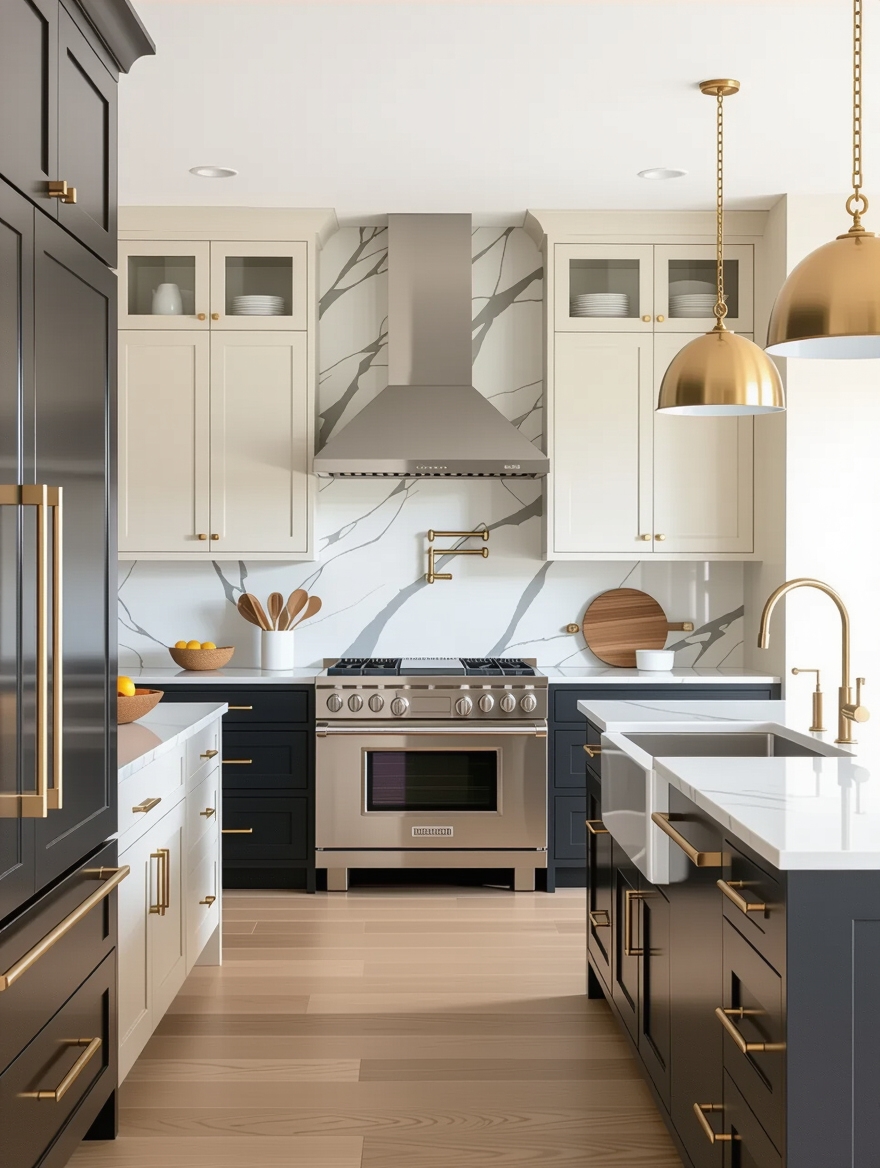
Color can quietly tell you where each job happens. It helps most when two people share the kitchen. You don’t need anything loud; small shifts in cabinet or backsplash tone are enough to mark the runs as two zones.
- Give the cooking run a slightly deeper tone so it grounds the busiest wall.
- Keep the prep and sink run lighter to bounce task light onto the work surface.
- Carry one accent color across both runs, like the hardware, so the zones still belong together.
Who a Parallel Kitchen Suits Best
A parallel layout pays off most for people who cook real meals and want to move less while doing it. It also handles two cooks better than almost any small-kitchen layout, since the work splits cleanly across the two runs. If your room is long and narrow, this is often the most counter and storage you can get without building out.
It is a weaker fit for very wide rooms, where the runs end up too far apart to pivot between, and for cooks who would rather have an eat-in table than a second counter. In that case, a layout that opens toward a dining area or makes room for a breakfast nook may serve you better.
Parallel Kitchen Questions, Answered
?How wide should the gap between two parallel counters be?
Aim for 42 to 48 inches. That lets two opposite doors open at once and gives two people room to pass. Below 42 inches it starts to feel cramped, and above 48 you lose the easy pivot that makes the layout efficient.
?Is a parallel kitchen good for a small apartment?
It can be one of the best small-space layouts, as long as the room is at least about 8 feet wide so you keep a usable aisle. In a narrower space, a single-wall or compact galley setup usually fits better.
?Can two people cook in a parallel kitchen at the same time?
Yes, and that is one of its strengths. Put the stove on one run and the sink and prep on the other so each cook owns a side and nobody has to cross the other’s path to reach water or heat.
Two Runs, One Easy Rhythm
A parallel kitchen rewards planning more than budget. Get the gap between the runs right, split the cooking and prep across the two walls, and light both counters properly, and the rest falls into place. Most of these moves cost a few hundred dollars or a free weekend, not a full renovation.
Start with a tape measure and the 42-inch aisle. Once you know the room can hold the layout, the storage, lighting, and color choices are just fine-tuning a setup that already works the way you cook.
More Hair Ideas


