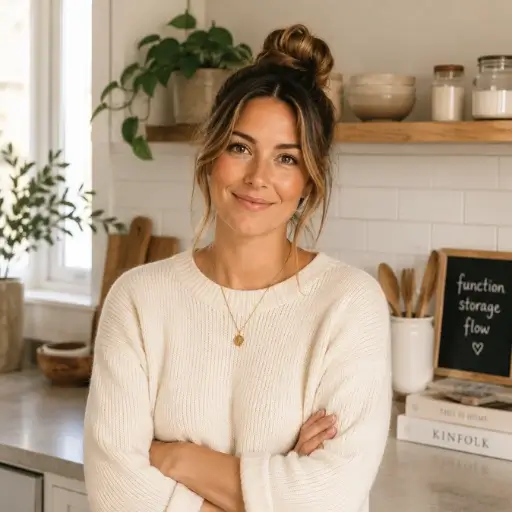

Open shelves look easy in photos and chaotic in real kitchens, and the gap between the two is almost never the stuff; it is the rules. The same dishes that read as clutter on your shelf would look styled on a designer’s, because they followed a handful of simple principles you can copy. Steal these rules and your shelves stop fighting you.
These are the styling rules that turn a jumble into a deliberate display, from the clean base that everything starts with to the texture and greenery that finish it. None of them cost a thing, and most take ten minutes, so let me walk you through how to make open shelves look as good in your kitchen as they do on the boards you saved.
The Rules in Short
- Edit first: start from empty and add back only what you love and use, since a clean base is half the styling.
- Keep a tight palette: a few repeating colors and materials make mismatched pieces read as a collection.
- Group in odd numbers and vary heights: clustering and a tall-medium-low rhythm is what makes a shelf look designed.
- Mix useful and pretty: everyday dishes plus a few decorative pieces keep open shelves both styled and practical.
Start With a Clean, Clutter-Free Base

Every styled shelf begins the same way: empty. Take everything off, wipe the shelves down, and start from a blank slate, because you cannot arrange your way out of a crowded shelf. Editing is what everything else depends on, and it is the step most people skip in their hurry to decorate. In my own kitchen I keep open shelving to one short run, because anything more becomes a dusting chore I resent.
From empty, add back only the pieces you truly love or use daily, and be ruthless about the rest. A shelf with a few well-chosen things and room to breathe always looks more styled than one crammed full, so resist the urge to fill every inch. The empty space is part of the design, not a gap to plug.
This clean base is also what keeps open shelving practical, since the less you store on display, the less there is to dust and reset. Start clean, add back slowly, and you are already halfway to a shelf that looks like a designer touched it, the same instinct behind any expensive-looking shelf arrangement.
Balance Open Shelves and Closed Cabinets

Behind every styled open shelf in a photo is a lot of closed storage doing the quiet work. The fix is balance: a little open, a lot closed. Open shelves are for the curated, photogenic minority of your kitchen, while the mismatched, bulky, ugly-but-necessary majority belongs behind cabinet doors. Trying to store everything in the open is what turns shelves into clutter.
Decide what earns a spot on display, your prettiest dishes, glasses, and a few decorative pieces, and hide the rest. This balance is what lets open shelving stay styled without forcing you to own only beautiful things, the same logic behind a smart open-and-closed display.
- Reserve open shelves for dishes and pieces worth seeing
- Hide the bulky, mismatched, and rarely-used behind doors
- Aim for a mostly-closed kitchen with a curated open slice
💡The ten-minute shelf reset
Set a ten-minute timer and treat one shelf at a time. Clear it, wipe it, then add back only what fits the palette and you actually use, building tallest-to-shortest and back-to-front as you go. Working one shelf at a time, on the clock, keeps the restyle from sprawling into an all-day project you abandon half-done.
Choose a Cohesive Color Palette

Here is what makes a shelf of mismatched objects look like one collection: a tight color palette. When your dishes, jars, and decor share a few repeating colors, the eye sees them as belonging together, even if no two pieces match. A cohesive palette is the cheapest way to look styled, since it works with what you already own.
Lean on a neutral base, white, cream, wood, stone, and let one or two accent colors repeat across the shelf. The pieces that fall outside the palette are the ones that read as clutter, so tuck those away. A calm, repeating palette is what separates a designer shelf from a junk drawer on display.
- Build on a neutral base: white, cream, wood, and natural stone
- Let one or two accent colors repeat across the shelf
- Hide pieces that fall outside the palette, since they read as clutter
Mix Functional and Decorative Items

The best open shelves blend the useful and the pretty, which keeps them both styled and practical. A stack of everyday plates beside a piece of pottery, a row of glasses next to a small plant, the working dishes you reach for daily double as the display when you choose attractive ones. Functional pieces keep the shelf honest, while decorative ones give it character.
The move is to let your daily dishes be part of the display rather than hiding them, so invest in versions you like to look at. When the things you use every day are also the things on display, the shelf stays easy to maintain, since using and resetting them is the styling, the same payoff behind a designer’s shelf decor formula.
- Let everyday dishes you love double as the display
- Mix in a few decorative pieces: pottery, a plant, a small artwork
- Choose attractive versions of daily items so they earn their spot
📋Before you call a shelf ‘styled’
- ✓Did you start from an empty, wiped-down shelf?
- ✓Is the palette tight, with a few repeating colors and materials?
- ✓Are pieces grouped in odd numbers and varied in height?
- ✓Is there one special or vintage piece anchoring the display?
Group Items in Odd Numbers

Group in odd numbers, the oldest styling trick there is, and it works because odd-numbered clusters feel more natural and balanced to the eye than even ones. Threes and fives read as composed, while pairs and fours look stiff and matched. Cluster your pieces rather than spacing them out evenly, and even simple objects start to look arranged.
- Arrange pieces in groups of three or five, not pairs or fours
- Cluster objects together rather than spreading them evenly
- Let groupings overlap slightly so pieces relate, not stand alone
- Vary the shapes within a group so it reads collected, not matched
Vary Heights and Sizes for Depth

Nothing flattens a shelf like everything sitting at one level. Varying the height and size of your pieces gives it rhythm and depth, since a mix of tall, medium, and low draws the eye across and makes the display feel alive. The difference in heights is what separates a designer shelf from a row of stuff.
Use the practical and the decorative to create that variation, with a tall pitcher or vase, a medium stack of bowls, and a low dish or a trailing plant. If a piece is too short for the spot, set it on a small stack of books or a riser to lift it; I reach for a couple of cookbooks for this constantly. Height is the easiest thing to get right and the one that changes a shelf most.
- Include a tall element: a vase, a pitcher, or branches
- Add medium pieces like stacked bowls or a row of glasses
- Finish with something low and wide so the eye has a base to rest on
ℹ️Good to Know
Open shelves carry real weight, so keep your heaviest pieces, stacks of plates, big bowls, on the lower shelves, and mount any shelf into studs or with rated anchors. A high shelf loaded with heavy dishes is a hazard, not a styling win, so plan the weight before the look.
Layer Smaller Pieces in Front

Layering gives a flat shelf real depth, and it could not be simpler: put larger pieces at the back and smaller ones in front. Leaning a small board or a piece of art against the wall behind, then setting a bowl and a little plant in front, creates front-to-back dimension so the shelf looks composed rather than lined up. The overlap is what makes it feel styled.
This works because it mimics how a designer builds a vignette, in layers rather than a single row. A piece of art or a tray leaned at the back, a medium object in the middle ground, and a small accent up front gives the eye somewhere to travel. Even a shallow shelf gains depth this way.
Keep the front pieces low enough to see what is behind them, so nothing is fully hidden, and the layering looks intentional. That front-to-back trick turns a one-dimensional shelf into a little staged scene.
Curate With Varied, Unmatched Pieces

A full matching set looks like a showroom, so resist the urge to display one. The shelves I love most in clients’ kitchens are always the mismatched ones: a thrown bowl, a smooth glass, and a wooden board read as collected and warm, where a perfect set feels flat and impersonal. The variety is what gives a shelf personality.
This does not mean chaos, since the tight palette from earlier holds the mix together. Within those repeating colors, vary the forms and materials freely, a thrown bowl beside a smooth glass beside a wooden board, and the shelf feels gathered over time rather than bought in one trip. Curated beats matched every time on an open shelf.
Add Texture to Make Shelves Pop

Texture gives a shelf depth and warmth that color alone cannot. Mixing smooth ceramic with rough wood, woven baskets with cool metal, or matte stone with a glossy glaze makes each piece stand out by contrast, so the display feels layered and rich rather than flat. Texture is what makes a calm, neutral shelf still feel interesting.
Vary the Texture, Keep the Palette Calm
Lean on natural materials especially, since wood, stone, rattan, and linen bring an organic warmth that hard surfaces lack. A woven basket to corral the messy bits, a wooden board leaned at the back, and a stone or ceramic vessel give a shelf tactile variety within a quiet palette.
The trick is keeping the colors calm while letting the textures do the talking, so the shelf looks considered rather than busy. A mix of two or three textures is the quiet secret behind almost every shelf you admire.
Highlight Vintage Focal Points

One special or vintage piece, used as a focal point, is what makes a shelf feel personal and collected. An antique crock, a handmade bowl, a piece with a story, draws the eye and gives the whole display an anchor, lifting it above a row of store-bought objects. It is the difference between a styled shelf and yours.
You only need one or two such pieces, since the goal is a focal point, not a flea market. Let a single characterful object sit among the more neutral, useful pieces, and it grounds the shelf in something real. A vintage find is also the cheapest move here, often a few dollars at an estate sale, and the one no one else can copy.
- Anchor the shelf with one vintage or handmade focal piece
- Keep it to one or two so it stays a focal point, not clutter
- Hunt flea markets and estate sales, where real character costs little
What to Expect: Putting the Rules Together
Here is how it looks in practice on one shelf, in about ten minutes. Clear it, then lean a wooden board at the back and set a stack of three white plates beside it. Add a tall jar of utensils, a low bowl of lemons in front, and one vintage crock as the anchor, all in the same calm palette. Step back, pull one thing off, and you are done, with a shelf that earns a second look.
A couple of practical rules round it out, since these shelves still live in a kitchen. Keep heavier items on lower shelves so a high shelf never becomes a hazard, store your most-used pieces within easy reach, and use matching containers for dry goods so the pantry stuff looks tidy too.
Add a trailing plant for life, step back, and remove one thing, since editing is the move you will use most. So which of your shelves would you restyle first? Start there, and yours can look as good as the shelves that made you want to try, much like a designer’s shelf decor formula.
Steal the Rules, Style With Confidence
Beautiful open shelves are not about owning special things; they are about following a handful of simple rules. Start from a clean base, keep a tight palette, group in odd numbers, vary the heights, layer for depth, mix useful with pretty, add texture, and anchor it with one piece you love. Do that, and the dishes you already own start to look like a stylist arranged them.
Above all, edit more than you add, and remember these shelves still have to work in a real kitchen. Steal the rules, style with confidence, and keep what you use within reach, and your open shelves will look composed every day, not just the afternoon you arranged them.
More Looks We Love


