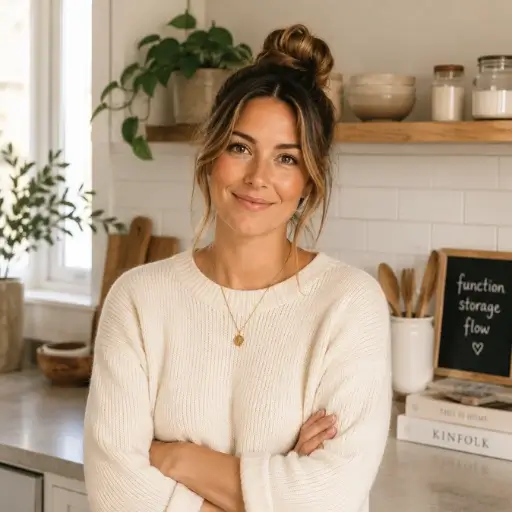

Open shelves look easy in every photo, which is exactly why they trip people up. The pictures show three perfect bowls and a sprig of eucalyptus; your real shelves hold the cereal box, a phone charger, and a mug you keep meaning to put away. The shelves themselves are not the problem.
What makes a display actually pop is editing, height, and a color story you stick to, and I will come back to those three in every idea below. Here is how to style open shelving so it looks deliberate and calm, with the practical notes, which kitchen each idea suits, and the dust-and-grease truths the glossy shots leave out. If you want the higher version of this same move, our above-cabinet styling guide pairs well.
Open Shelf Styling, Answered Fast
What makes open shelves look styled and calm? Editing and negative space. Leave a third of each shelf empty, group items in odd numbers, and stick to two or three repeating colors so the eye groups it as one set.
Are open shelves hard to keep clean? Honestly, yes, near the stove. Grease and dust settle on everything within a few feet of cooking, so display the dishes you use weekly there and save the pretty, untouched pieces for shelves farther away.
Where should I even start? Pull everything off, wipe the shelf, and put back only what you love or use. Most shelves look better half as full as they started.
What a Stylish, Organized Kitchen Display Really Needs

Before any single idea, three things separate a display that pops from one that just looks full. The first is editing: a shelf with eight things on it almost always beats one with twenty, because the eye needs somewhere to rest. The second is height variation, so the line of your stuff rises and dips along the shelf.
Edit first, decorate second
The third is a tight color story. Pick two or three tones that already live in your kitchen, the wood of the counter, the black of the faucet, one accent you love, and let almost everything fall into that range. The single most common fix I recommend in a styled-but-not-working kitchen is pulling a third of the items back off the shelf.
None of this costs money, which is the quiet appeal of open shelving. You are working with what you own and the empty air around it, and that air is doing as much styling as the objects are. If you only take one rule into the rest of this list, make it the empty space.
Choose Shelf Styles That Complement Your Kitchen

The shelf itself sets the tone before you put a single bowl on it, so start from the kitchen you already have. Thick wood brackets feel warm and farmhouse; thin floating shelves feel modern and quiet; black metal suits an industrial or transitional room. Get this wrong and even a perfect display fights the space. A quick way to test a style before committing is in our open shelving ideas roundup.
- Echo a finish already in the room, your hardware, faucet, or window trim, so the shelves look built-in
- Floating shelves keep a small kitchen airy; bracket shelves carry more weight and feel cozier
- Depth matters more than people think: 10 to 12 inches holds dinner plates, while a shallow 6-inch shelf is for small bowls and styling only
A few terms that come up when you start styling shelves:
📖Floating shelf
A shelf mounted on a hidden bracket so no support shows underneath. Feels modern and keeps a small kitchen feeling open, but holds less weight than a bracketed shelf.
📖Negative space
The empty area you deliberately leave around objects. On open shelves it does as much styling work as the objects themselves; aim to keep about a third of each shelf clear.
📖Color story
The two or three repeating tones you let a display stick to. Pulling your colors from things already in the room, the counter, the hardware, makes shelves look planned and pulled together.
Style Minimalist Open Shelves for Quiet Elegance

Minimalist shelves are the most forgiving place to start, because the whole look is built on leaving things off. You are after a calm, monochrome feel: a short stack of white plates, two matte mugs, a single sculptural bowl, and a lot of space around them. The restraint is the design.
Where this usually goes sideways is the temptation to add one more thing, then another, until the calm is gone. Decide on a small number of pieces and stop there. If a shelf still feels empty after a day, that is just your eye adjusting. Leave it be.
- Keep to one or two materials, all ceramic and glass, say, so nothing jumps out
- Stack horizontally and vertically both, a few plates flat with a bowl on top, to add quiet height
- Leave the outer thirds of each shelf nearly bare; the negative space is what looks expensive
Build Cozy, Rustic Farmhouse Shelves

Farmhouse style is the warm, layered cousin of minimalist: it wants texture and a few pieces that look like they have a history. Reclaimed or chunky stained wood shelves, stoneware crocks, a wooden cutting board leaned at the back, and a couple of amber glass jars give you that gathered-over-time feel without much effort. A small trailing plant softens the whole thing.
The honest trade-off is that this look tips into cluttered faster than any other, because the charm comes from layering. Keep one or two shelves a little fuller and let the rest breathe, so the eye still has somewhere to rest. A reclaimed-wood shelf runs roughly $25 to $60 at most hardware stores, and the worn finish hides grease far better than a glossy white one.
How to style a shelf from scratch in four moves:
1Clear it and wipe it down
Take everything off, clean the shelf, and start from empty. You cannot judge a display while last month’s clutter is still on it.
2Anchor with the biggest piece
Set your tallest or boldest item first, a large bowl, a leaned board, a vase, off to one side so the eye has a starting point.
3Build small groups around it
Add items in odd-numbered clusters at different heights, grouping by color or material so each little group reads as one thing.
4Pull a third back off
Step across the room and remove whatever your eye trips on. The shelf almost always looks better with less than you first put on it.
Energize Open Shelves With Colorful Dishes

Color is the cheapest way to make shelves pop, and you probably already own it in the form of dishes you never display. The trick is repetition. One orange bowl looks accidental, and three of them across two shelves looks planned. Pull your most colorful everyday pieces forward and let them do the work.
- Pick one or two accent colors and repeat each at least twice so the palette looks deliberate
- Anchor bright pieces against a neutral base of white or wood so they stand out instead of clashing
- Use the things you reach for daily. Color you actually use stays dusted; display-only pieces go grimy fast
Mix Textures on an Open Shelf Display

If you love a neutral palette but your shelves look flat, texture is usually the missing piece. Smooth glazed ceramic next to a rough wooden board, a woven basket beside a glass jar, linen folded under a stack of plates: the contrast gives the eye something to do even when everything is the same quiet tone. This is the move behind most shelves that look expensive without spending much.
- Pair one rough material with one smooth in each grouping, wood with porcelain, weave with glass
- Add a soft element, a folded linen towel or a small woven trivet, to break up all the hard surfaces
- Keep the colors muted so the texture, not the hue, carries the interest
Two quick gut-checks before you call a shelf done:
1Can your eye find an empty spot to rest?
If every inch is filled, pull a few things off. Open shelves need negative space to read as styled rather than stuffed.
2Do the colors repeat, or is everything a one-off?
A single bright piece looks accidental. Repeat each accent color at least twice across the shelves so the palette looks deliberate.
Show Off Collectibles With Style

Open shelves are a low-stakes stage for the small things you actually love, the vintage creamers, the pottery from a trip, the row of mismatched mugs with a story. Grouped well, they add the personality a catalog kitchen lacks. Scattered, they just look like things you have not put away yet.
I tell everyone to group by one shared trait, color, material, or era, so a handful of pieces holds together as a collection. Five strong things beat fifteen so-so ones, and the ones you cut can rotate in later when you want a change.
- Cluster collectibles together rather than spreading them across every shelf
- Give the group one common thread, all white, all brass, all 1970s, so it looks gathered on purpose
- Edit ruthlessly and store the overflow; a tight edit always looks more deliberate than a full shelf
Maximize Vertical Space on Open Shelves

When shelf space is tight, the air above each stack is wasted real estate, and a few small moves double what a shelf holds without making it look crammed. A cake stand or a small wooden riser lifts a second layer of items into view, hooks under the shelf catch mugs, and stacking like-with-like keeps the whole thing legible. For more of this thinking in a tight room, our small-kitchen storage tricks guide goes deeper.
- Add a riser or inverted bowl to create a second tier for short items
- Screw a row of cup hooks into the underside of a shelf, around $4 for a pack, to hang mugs and free the surface
- Stack plates and bowls in tidy columns so vertical storage still looks composed, not piled
Freshen Shelves With Plants and Greenery

A little green is the fastest way to keep a shelf from feeling static, and a single trailing plant breaks up the boxy line of dishes better than any object. I love a single pothos spilling off the end more than three matched pots fighting for room, and a small herb or a few cut stems in a jar do the same job. They bring life to the display and tie a neutral palette together.
Be realistic about light, though. Kitchen shelves are often dim and warm, so pick low-light plants like pothos or a snake plant, or go with good faux greenery for the spots that get no daylight at all. Nobody keeps watering a plant they cannot reach over the stove, so put the living ones where you will actually tend them.
Balance Open Shelves With Closed Storage

The kitchens that pull open shelving off rarely go all open. They pair a run of open shelves with closed cabinets or drawers below, so the beautiful pieces are on display while the mismatched storage containers, the spice clutter, and the kid cups stay behind doors. That balance is what keeps the open part looking curated.
Aim for roughly one-third open, two-thirds closed
A good ratio is open shelving for the top third and closed storage everywhere you store daily, working clutter. If you are nervous about committing, start with one short run of open shelves above the counter and keep everything else closed. You can always open more up later.
The worry I hear most is whether anyone will really keep open shelves dusted, and the closed cabinets below are what make that answer yes. They absorb the things that would otherwise pile onto a shelf, which keeps the open part sparse enough to wipe down in a couple of minutes. For the wider storage picture, our declutter-friendly kitchen plan lays out where everything should live.
Quick Styling Tips That Keep Shelves Looking Good
A few habits keep a styled shelf from sliding back into clutter within a week. Style in odd numbers. Groups of three and five look intentional, and pairs can feel stiff. Vary the heights inside every grouping, and let the tallest piece sit off to one side rather than dead center. Always leave the front edge of each shelf clear, because that sliver of empty space is what makes the whole thing look finished.
On the practical side, accept that anything within a few feet of the stove gets greasy, so display dishes you wash often there and save the untouched pretties for the far end. Give the shelves a two-minute wipe every couple of weeks, and rotate a piece or two with the seasons, a few branches in fall, brighter glass in summer, so the display feels current without a full redo.
For a tighter set of rules to work from, our open shelf styling rules guide is a good next read.
Open Shelving Questions People Actually Ask
?Do open shelves get greasy and dusty in a kitchen?
Yes, especially within a few feet of the stove, where cooking film settles on everything. The fix is to display dishes you use and wash weekly in that zone, keep decorative-only pieces farther from the range, and give the shelves a quick wipe every couple of weeks. Faux greenery and glazed ceramics handle grease far better than paper or fabric.
?How much should I actually put on an open shelf?
Less than you think. A good guide is to leave about a third of each shelf empty and group the rest in odd numbers. If a shelf feels bare for a day or two, that is usually your eye adjusting to the negative space, and the shelf is probably fine as is.
?Are open shelves a good idea in a small kitchen?
They can be, because removing upper cabinet doors makes a small kitchen feel more open and airy. The catch is that everything is on display, so they work best paired with closed lower storage for clutter, and styled lightly with a few repeated colors and plenty of breathing room.
Style One Shelf This Weekend and Build From There
Open shelving that pops comes down to editing what you have, repeating a few colors, and leaving real space around it all. Pair the open run with closed storage, keep the greasy zone practical, and dust now and then, and a plain shelf turns into the part of the kitchen people quietly notice.
So pick one shelf, clear it off, and rebuild it from a single anchor piece this weekend. Once you see how much better half-full looks than crammed, which shelf do you think you will redo next?
More Hair Inspiration


